Can we talk?

Today is 23 July 2011. I’m writing from the suburbs of Chicago where it has been storming all night and we are experiencing a power outage. This is not funny. Yet, I’m am inclined to laugh. Why? Well, for starters, this morning I am meant to be meeting some people at the beach – reviving a high school tradition of breakfasting at the beach before going to class. Of course, we would drive there – it is about a twenty minute drive. Now, I suspect – there being a power outage – no one is going – homes with small children will be in a state of morning chaos without electricity or hot water. In my case, the issue is that I cannot get the car out of the garage – it’s electric!  I see a cord dangling, and I’m sure that is the key – but the car is parked smack in the middle of the garage and makes access to the cord difficult. I am compelled to laugh because it seems totally absurd. But this no laughing matter. Here I am confronted by no electricity, and it is a prompt to consider seriously the ways in which I/we have become crazily dependent on it. It also a prompt to consider seriously what is ‘good’ and ‘just’ in this world.

Now you may think this will turn into an ‘anti-consumerist’ rant – but it will not. Sure, consumption is on my mind. But I am also conscious of the ways in which lack of electricity means more than being without a car. In a hospital or care home it is, for example, life threatening. The truth is, I’ve never thought of myself as an ‘environmentalist.’ Recently, however, I’ve found myself writing about the Belo Monte dam project. My primary interest in it is its displacement on the Xingu River peoples.  I engage with it primarily as an issue of human rights and self-determination, though I’m conscious of the environmental aspect, e.g. deforestation of the Amazon.

Access to electricity is at the heart of the Dam controversy. The Brazilian government is prepared to build a dam because it wants electricity for more of its people, which will in turn stimulate economic growth while decreasing poverty. Building the dam is being pitched as key to the economic and social well-being of Brazilians.  Wow. That is quite a narrative to be following.

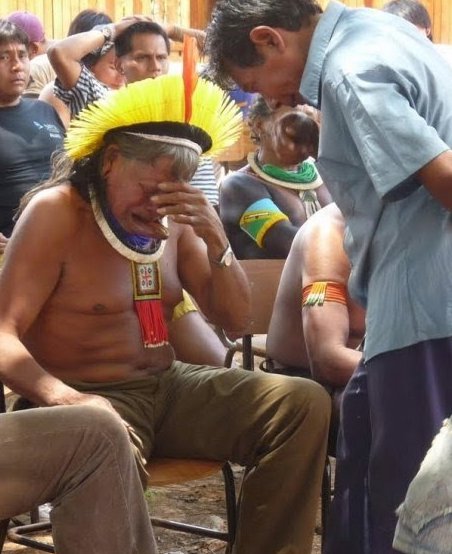
I came to the dam controversy wearing my hat of moral outrage – having seen a picture of a sobbing Chief from the Xingu River peoples. I still feel that outrage, but  it is now tempered by an awareness of the complex range of issues and tensions at hand. I wrote about this last week. Stamping my foot and saying ‘No Dam’ is all well and good – but what about the underlying policy challenges: how to bring electricity to Brazil; how to do so in a with negligible disruption to the natural environment and indigenous communities; how to create jobs and decrease poverty? To challenge the narrative that has led to the building of the dam, we must look closely at its different core threads.

With each day, I’m wanting to explore this controversy further. It encompasses the essential challenges and complexities to building a fair and just world, to democracy, to harmonious living with each other and the planet. The decision to build the dam is laden with values, beliefs, and assumptions about human relationships and our relationship with nature. Yet, the deliberations surrounding the dam seem to sidestep or marginalise open discussion of values, beliefs and assumptions. Last week, I called these ‘grey areas.’  And today as I sit here, sans electricity, I’m becoming more and more passionate about provoking myself and others to engage with the ‘grey’ areas, with what the Institute for Global Ethics calls ‘right versus right’ dilemmas, with our fundamental beliefs and values.

I get the impression many people think that opening up deliberations about moral, social, and economic beliefs and values is what closes arguments down; that these are the seeds of stalemate and deadlock. But the opposite it true. We sidestep open discussion of these topics at our peril. Our moral codes, our beliefs, and our values are what guide us in our decisions and choices. If – in the name of progressive social change – we are wanting to people to make different decisions and choices – than we must create the spaces where we can be reflective on what we believe in and what is important to us. Only then can we move beyond ‘I’m right and your wrong’, stalemates, and resentment over what seem like unjust decisions. Only then can we being to ask and address ‘How can we move forward together and in ways that bring out the best of who we can be as human beings?’
 

Posted in Uncategorized | Tagged , , | Leave a comment

Going Grey: a reflective and fruitful journey….

You are in a heated argument with a colleague and each of you is passionately making the case for your position. Then comes along a third person who listens to both of you for a bit. Finally one of you asks her what she thinks. She pauses before she answers and then says: “I understand the rationale behind your respective polar positions…But I cannot take a side. It’s more complex than either of you is articulating.  It seems to me that entrenched as you are in your positions, you are failing to engage with important questions which could help you achieve a constructive, more legitimate solution.” Your adrenalin plummets and you feel deflated. Both you and your opposing colleague are at a loss for words. You both make excuses for ending the conversation and go back to your offices. 

Shades of grey can be disappointing. Engaging with grey can temper the passions, the anger, the sense of righteousness and being on the high ground. It can feel much less exhilarating than having a stance and not budging. But most of our decision-making dilemmas exist within shades of grey. If we want to create a different world – one more aligned with values of justice, compassion, respect, responsibility and honesty – we need to embrace the grey. We need to play with it – the grey space is a playful space where we have the opportunity to use our agile minds in identifying connections that open up new understandings and possibilities for action. That is not to say we must not argue and debate. No, not at all. The point is that exploring and playing in the land of the grey can lead to arguments and debate rooted in a nourishing soil likely to result in more expansive and fruitful thinking. But to journey fruitfully in grey lands we need to be prepared to let down some defenses, to be reflective and honest with ourselves and others, to dig into and challenge our assumptions and beliefs, to let go of our egos, to ask questions before we give answers. 

Two prominent issues in environmental activism have been influencing my recent thinking on the grey lands: Tar Sands drilling in Canada and the Belo Monte dam in Brazil. I learned bout Tar Sands from Liam Barrington-Bush. A couple of months ago, Liam experienced a very powerful journey into the land of the grey.  The brief summary: He was in Canada with a delegate of young British activists (People & Planet) and they heard a tribal Chief talking. He could see the anguish in the Chief’s face. The Chief pulled everyone into the grey lands by telling them about how his peoples had once been fur-traders. This had been an important source of income. Then, the environmentalists/animal rights activists protested against fur-trading. When the fur-trading stopped, so did the income. Along came industrialists eager to drill – tar sands are a rich source of fuel and are seen as a profitable alternative to/replacement for crude oil. When drilled, Tar Sands are also a huge source greenhouse gases and generally are destructive of the land. Environmentalists are now protesting against Tar Sands. 

The Indigenous peoples for the Alberta region in Canada where Tar Sands are prominent historically have a strong relationship with the land – with Mother Earth. Like their non-Indigenous activists, they are outraged by the drilling when they think of what it does to the environment. But they also aren’t very welcoming of unemployment and poverty in their communities. For the Chief to say ‘no’ to drilling is still leaves the anguished question: ‘Where will our income come from?’

The issue of the Belo Monte Dam in Brazil recently captured my attention courtesy of a heart-touching June picture on Facebook (see below, Chief Raoni Chief crying when he learned that the President of Brazil approved the Belo Monte dam project on the Xingu indigenous lands).

Xingu_chief_in_tears

The dam is going to displace anywhere from 20,000 (official statistics) to 40,000 Indigenous peoples living along the Xingu River. The argument by the Brazilian government and the industrialists is that the dam will result in electricity for Brazilians (a country with a population of 190,732,694) and in turn lead to economic growth, employment and decreased poverty. One could make the utilitarian rationale here: an important ‘good’ is being created for the majority of Brazilians. Of course, what’s good for the Brazilians is not very good for the Xingu River peoples.

Compared to the Tar Sands issue, the Belo Monte dam might not seem very ‘grey.’  In one respect I don’t think it is: I believe it is ethically wrong to displace people from their lands and to deforest in the Amazon. I’m in the ‘No Dam’ camp for sure. Yet, saying ‘No Dam’ doesn’t address the issue of poverty in Brazil. Nor does it address the desire Brazilians have to be have regular access to electricity. I’ve read that while many Brazilians are sympathetic to the plight of the Xingu River peoples, they also want to improve their standard of living. Are they wrong to have the aspiration?  

So much can be written about both these issues, and I’m not an expert on either. But what I do know for certain is that at the heart of both – in the grey lands – is a hotbed of controversy not about ‘to drill or not to drill’ or ‘to build the dam or not to build’ but about our values as human beings who live on a planet we share with each other and with all the other creatures inhabiting it.  We make decisions based on our values, assumptions and beliefs – conscious and unconscious. Some fundamental differences in values, assumptions, and beliefs underpin our disagreements in decision-making, e.g. one’s understanding of our relationship with earth and other creatures, the moral perimeters we set for ourselves, the responsibility we are prepared to take for our actions, our sense of how we as individuals and communities are connected with each other and impact on one another’s well-being.

Amidst all our differences, I believe we have shared core ethical values and most of us would prefer to uphold those values than not.  Yet, the truth is that sometimes our social and economic values, beliefs, prejudices and assumptions create situations where we undermine our ethical values – albeit unwittingly. For example, we talk about respect and responsibility and we uphold those values for a particular community. At the same time, the manner by which we are upholding those values is disrespectful and irresponsible when it comes to the interests and needs of other communities.

The grey lands – they aren’t simply all around us, but they are within all of us. Crucially, this notion of ‘unwittingly’ undermining our values should be a wake up call, but is often used as an excuse for complicity. What the Tar Sands, Belo Monte Dam and other similar issues are shouting out for us to do is to open our eyes, seek greater awareness of how we are moving through the world individually and together – journey into the grey lands in search of illumination, see and connect with the intricate dynamics within them.

Arguments about ‘You’re right and I’m wrong’ constrain us as creative human beings. They encourage us to start with an answer rather than a question. Going to the grey lands begs us to begin with a question. What if, for example, we were constantly asking: ‘How can we work together to be the best of we can be as human beings – for each other and for the planet?’ 


Posted in Uncategorized | Tagged , , | 2 Comments

Communication – the means might just determine the end….

It’s all about communication! How successful we are likely to be in achieving what we want to achieve is all about communication. Well, maybe not ALL, but a fair portion of our success lies in how and what we communicate with others. Here’s the story that has me focusing on this today:

I live on an estate managed on a day to day basis by us residents – we have a resident run company. En route to my stairwell this evening, I passed a fellow resident and said “Good Evening!’ He asked if I had seen Ed. I hadn’t and asked him what was up, as he was frowning. He – le’ts call him Jack – explained that he was having plumbing problems and was looking for Ed to help him out. Jack’s kitchen sink had not only been blocked but had been spewing out awful, smelly stuff. For the time being the problem had been solved – Jack had used really strong chemicals to clear it out after plunging didn’t work. After explaining this all to me, Jack then said:  “If it happens again I am going to call the police and say someone is doing drugs on the estate!” I did not quite get the connection, so asked him to elaborate. His rationale was that it can only be drugs that would be blocking up the drains like that.  

Hmmm.

My response: ‘Well you don’t know that drugs have anything to do with your sink problem and I’m not sure calling the police would help anything. Have you told Pete?” Pete is the resident Director of Building Maintenance. “Yes, and he told me to find Ed’, Jack replied with a slightly raised voice and added “Typical, always passing the buck on to others.” Knowing that Pete takes his Director role very seriously, I suggested it wasn’t the case and that we go knock on Pete’s door and have a chat.  

As we walked up the stairwell, Jack asked me: “So you think he’ll listen to you more than he did me?” I said I thought that two residents are more powerful than one and that it is a matter of how the issue is communicated. So, we knocked on Pete’s door, and I explained that I had bumped into Jack and that Ed was not home. Pete explained that a plumber needs to determine the cause of the overflow – whether or not it is the external drain pipe or something in someone’s flat – and that Ed is a plumber. Pete also talked about a previous problem there had been on the estate and how it had long costly process of getting it fixed, how old the plumbing was and so forth. Jack responded to this by focusing on the fact that it clearly wasn’t his fault and told his story of all that he had to go through to deplug the train, emphasizing that he had heard someone wandering up the landing the day before with a similar problem. 

What was I doing while all this was going on? I reframed the dialogue. For example, I clarified for Jack (because I could tell that Jack wasn’t hearing this from Pete’s explanation) how the process works here – that internal plumbing matters are the resident’s responsibility. We are obliged to call in a plumber and if they conclude the source of the problem is external than the Management company gets involved. But the first step is identifying the source of the problem. I stressed that Pete was offering up Ed as person who would have a look for free, when Jack said that calling in a plumber would cost a fortune. I empathised. For example, I said to Ed that I could see he was frustrated and fearful – what if this happened again and was something he couldn’t fix?  I also reminded him it was frustrating for all us residents that this is how the process works – with the aim of helping him feel connected with others in his experience.

By the end of the conversation, Jack suggested to Pete that he thought the cause might be someone’s dishwasher and the food waste going through it. I assumed – that being the case – he no longer thought a call to the police would be appropriate should he have plumbing problems in the future. Pete gave Jack Ed’s mobile number and told him to give Ed a ring and say that they had spoken. He assured Jack that he would get to the bottom of this matter.

Why did I get involved? I’m a qualified and practicing mediator. I suspected that a a conversation at the end of a workday between an angry, frustrated, sceptical and worried resident and the Maintenance Director (who I knew had the spent the past week grappling with the tough and costly issue of window repairs) would not go well if they were left to their own devices. With this suspicion in mind, I made the suggestion to Jack that we go talk to Pete together. I wanted to facilitate expansive and constructive communication. I wanted Jack to feel satisfied that his concerns had been heard and taken seriously. Jack shook my hand as we parted and I said if he bumped into me again he must let me now how it all unfolds. As I was walking away for him, he paused to ask another resident who was just coming home if he was having plumbing problems. In fact, he was – and I found myself thinking that perhaps now Jack will feel less isolated in all this and that will be a source of comfort. As for Pete, I didn’t want him to be shouted at and/or bullied for what Jack had felt was a dismissive response when he first raised the issue. I don’t think it was dismissive to tell Jack to find Ed. Rather, it lacked a necessary full explanation and an exchange that would have given Jack the sense of being heard and taken seriously. 

Generally, I wanted success, peace, and satisfaction for both of my fellow residents – and I knew that the key to getting that would be how they communicated with each other. And that a little help with that could go a long way.


Posted in Uncategorized | Tagged , | Leave a comment

A call out for ‘Movement’ Awareness…

I was at a gathering recently of about a dozen or so lefties – I’m sure everyone in the room would agree to the broad label. ‘Broad’ is definitely the operative word; the spectrum of beliefs within this group was interesting, if not highly entertaining and provocative. We talked about the recently publicised ‘boy banned from wearing corn-rows hairstyle to school’ issue; female genital mutilation, the movie MATRIX (which seems to have a very important social-philosophical message for some), national identity, human rights principles – are they really universal?; sexuality; sexuality in the workplace and more. We came from diverse backgrounds, a range of national, ethnic, racial and religious identities were in the room. I suspect we all came from similar class backgrounds, but cannot confirm that.

It was a social happening – which means people were laid back and felt comfortable (as far as I could tell) being honest – so honest that we had plenty of arguments.  These arguments included not just loud voices, but dismissive tones, talking over each other and other similar forms of communication. So, why am I sharing this? I am sharing this because of a reminder I took from it: we who call ourselves ‘progressive’ are a hugely diverse lot and while we can put aside our differences to focus on coalescing around broad shared values and judgments/critics about the ‘opposition’ we also might serve our selves well to be delving into how and why we disagree with each other, exploring how we move together when engaging with the more controversial areas. In short, I’m calling out for us to have greater ‘movement’ awareness.

A social movement requires a shift, motion – as the word ‘movement’ suggests.  A key question: ‘How are we moving? Applying the physical movement work I do to social movement, I see how we can think of ourselves as inhabiting three spaces (thank you, Ya’Acov and Susannah for this!): our deep internal space (what we are engaging with inside ourselves), the space immediately around us (how we start to move outwards, while still focused internally on what’s alive inside ourselves), and our wider space (how we move further outwards, giving awareness to and interacting with our surrounding environment). I’m inclined to call these spaces (I’m using different terminology than Ya’Acov and Susannah) internal, intermediate, and expanded. We are constantly moving within and between/across all of them. 

Thinking about this has got me reflecting on this space we call ‘progressive’ – and how we move within it, individually and collectively. I’m considering how each of us moves within our inner space, our intermediate space and our expanded space – and how we connect them all. I ask myself: what’s alive and moving internally, and how does this take form when I move in my intermediate space, and finally what shape does my internal movement take when I open it up into expanded space? Do I integrate with the movement around me? Do I carry on my movement regardless of what surrounds me? Do I find myself losing my sense of internal movement and become completely absorbed by the movement of others – and unconsciously imitate them or react to them without conscious agency of what I’m doing? 

How do these questions apply more collectively? What I’m thinking here is that if we are trying to grow a progressive movement, we all (whoever ‘we’ are) could benefit from reflection – in order to understand more clearly how we actually are moving – separately and together. When doing physical movement work, we come to awareness – for example – of repetitive motions we get stuck in, of movement we resist, of when we forget our inner and intermediate spaces and get totally absorbed by others in the expanded space. What might we gain if we apply the same practice – awareness – to our social movement, focusing firstly on the inner space and than moving outwards into the expanded space where we consciously connect (or not, as the case may be) with our ‘progressive’ peers? 

In working with our movement in this way, we can gain awareness of how we are moving – firstly among ourselves. We also can create the opportunity to transform our movement – reshape it, so that it flows more freely even while we are negotiating shared space with others. We can become aware of our patterns in negotiating shared space – constructively and destructively. We can explore new ways of moving and opening up our opportunities for engagement with our selves and others. Then, with this experience and awareness alive within us, we can expand out into wider, more challenging spaces, e.g. involving the ‘opposition’.

In doing so – expanding outwards – we would take with us a deep understanding of our movement. As a result, I believe, we will become stronger and more empowered ‘movers and shakers’. 


Posted in Uncategorized | Tagged , | Leave a comment

(IN)VISIBILITY – PART 2

I do a lot of work with movement/dance. Last weekend, I participated in a workshop where I was very conscious of this idea of (in)visibility. One woman stands out in particular. She is stunning looking in a host of ways – including a number of tattoos. I have seen her at other movement events and sense that she likes to be visible. The tattoos alone – in very readily seen places on her body – create a loud invitation to look at her. But also, the few times I’ve seen her, she has been always conspicuous in terms of being in the centre of the room or standing while everyone else is sitting. Again, I hear ‘ Look at me.’ This has me thinking about the ways we encourage others to look at us and the extent which we are limiting or expanding  what people see. The question that comes to mind is: How can we use our power to appear and disappear most effectively to bring about the change we desire?

I make a huge assumption with this question. I assume we have control over our visibility. At one level, this is fundamentally untrue. Try as we might, sometimes people simply refuse to see us. What then? What do we do? Well, I will come back to that particular issue in a future post. For now, I’m going to roll with the assumption: I/you/we can control and direct when and how we are seen – at least to some degree.

Our power is rooted in self-awareness. What do we see in ourselves that we want to make visible to those around us? What do we want to hide from others?

Social changemakers – whether in small or large ways – often are wanting to make our anger visible. We are driven to pursue change because of an injustice and wrong, a sense that ‘things should be different’ and we are angry that they are not.  What happens if we focus on putting our anger out there – on being seen as ANGRY?

Anger, depending on its form, will receive a variety of responses. And that’s the key – what form does our anger take? When a group of protestors burns down a bunch of shops, they are seen as angry – but also as reckless, disrespectful, dangerous, and perhaps stupid, i.e. if those shops are in their own neighbourhood. In such a situation, I imagine witnesses – those for whom the anger is meant – become less inclined to pause and ask ‘Why such anger?” or “What responsibility do I have to try and engage with this person’s sense of injustice?’ Rather than become curious, witnesses to such anger are more likely to become confused, dismissive and silent.

This is by no means a suggestion that we encourage violent anger by responding to it – by sending the message ‘be violent, it is the way to get seen and heard.’  Again, that raises a related but different topic. Nor is it to suggest that we avoid expressing anger. The pressing question is: What are the most effective ways of bringing our angry selves into visibility – the ways which encourage others to engage with it and us and the others aspects of our selves we want them to see, e.g., the creative problem-solver, courage, compassion?

I like to answer this question by focusing attention firstly on the source(s) of the anger. Why are we angry and what request(s) do we want to make of others to change what it is that draws us to anger? What aspects of our requests are fixed and what actually are fluid, i.e., we want a more fair decision, but we aren’t locked on one route to achieve that sense of fairness. Then I focus on the direction of the anger – to whom is it towards? In my actions, am I being truthful or misdirected, e.g., am I wrongly shooting a messenger for a message created by someone else?  Next, I wonder ‘What does escalation look like?’ That is, what does a request look like and if that meets resistance, what does my demand look like? When does it make most sense to request? To demand? What is the most effective way to express either?

I also am aware of a set of questions I think can get easily lost: How can I connect with the people who have the power to meet my request/demand? How can I connect with others who may be sympathetic to my request/demand – and support me in the asking? 

When people look at us, what they see is inevitably determined both by what we make visible and what’s alive in them and shapes the lens through which they are viewing us. The final set of questions coming to mind on this topic, for right now: What do I want people to see in me? How do I know if they are seeing it – and if not, what are they seeing in its place? If I’m hiding something – rendering a part of myself invisible – why am I doing that and what is the consequence?


Posted in Uncategorized | Tagged , , | Leave a comment

(In)visibility

“You ache with the need to convince yourself that you do exist in the real world…and you strike out with your fists, you curse and you swear to make them recognize you. And, Alas, it’s seldom successful.” The Invisible Man by Ralph Ellison 

I have so much I can say on this topic. Firstly, it always takes me back to the United States. I cannot hear the word ‘Invisible’ without thinking of Ralph Ellison’s Invisible Man – a seminal book describing the ways in which a Black man in the U.S. moves through his life invisible – seen through, rather than seen. Notwithstanding our Black President, this narrative line is still relevant. In my coaching work, I have been reminded repeatedly these past few months of how the status of invisibility is widespread, e.g. women in the workplace.

I suspect that the vast majority of us have at one point or another in our lives felt invisible. We all have this in common. Of course, invisibility plays out it different ways, is context-dependent in terms of impact, and is invariably tied in with the politics of power. Clearly, some forms of invisibility have more serious life implications than others.  

As said, I can say a lot on this subject. I believe it to be a very important one when it comes to social transformation. Where to focus? Today (I’m sure I’ll come back to this), I will focus on the ways in which we render each other invisible: 

·      Labels, boxes and roles – we are pushed or pulled into (e.g. through a desire for power) narrow labels, boxes, roles that others use to define us and we sometimes use to define ourselves and our relationships.

·      Constraining beliefs –we consciously and unconsciously are guided by beliefs (including assumptions and attitudes) often rooted in fear, judgement and focusing on limits, lack, and disconnect.

·      Silencing and lack of understanding – sometimes, due to lack of confidence, we keep quiet and other times we are silenced because others talk over us, bully and disparage us, tell us to keep silent, or effectively make us silent by making little effort to understand us.

·      Lack of self-awareness – We allow ourselves to move about without questioning our beliefs, motives and behaviours. We fail to observe the impact our thoughts, words, deeds and decisions have on our own self-perceptions and on our relationships with others; we forget to ask ‘In what ways could what I’m thinking, saying and doing, contribute more to my own visibility? To the visibility of others?  

The other day a friend described to me an incident at a UK Uncut protest in Hackney. Two young men from the neighborhood wanted to access the bank which was closed as a result of the protest. They shouted at the protestors – their language was decidedly vulgar and aggressive. At the heart of the conflict, according to one of these young men, was that he wanted to go into the bank to get money for food. He was questioning the protestors’ right to limit his access to the bank. In response, the protestors tried to explain why they were protesting and how, for example, his local NHS would be cut , e.g. maternity wards, while bankers were taking a fortune in bonuses and not paying their fair share of taxes. The young man’s response to this was – by the account I heard – vitriolic and to many ears shocking and offensive. In rather more vivid language, he suggested that in Hackney, people should value how good they have it –  say, compared to a woman in an African country giving birth.

As I listened to this story, I could easily picture the situation. Two sets of people talking at cross purposes – neither demonstrating that they understand each other. Later, at the scene, my friend offered one of the young men five pounds he had found on his way to the protest. He saw, in doing so, that the young man’s demeanor changed. He wasn’t so bold and brave anymore; rather, he responded to my friend with his eyes looking down and a polite ‘No thank you. I don’t take money from nobody.’ My friend tried to insist by saying ‘It isn’t mine, I found it – take it and go get some food.’

The young man declined again. He waited around until the bank re-opened, and my friend observed when he came out that he was clutching five-pound note. Presumably all he had wanted was five pounds – which you can’t withdraw from a cash machine – and some dignity to go with it.

My friend and I agreed it was a shame the opportunity was not more effectively taken for communication and connection. I imagine, from what I heard, a condensed summary of the story goes something like this:  The young men yelled and hurled invectives at the protestors. In response, finding it hard to be sympathetic to their verbal violence and vulgarity, the protestors did not engage with the issue raised by the young men. Instead, they focused on explaining the protest rationale. Because it gathered no sympathy from the young men, the protesters gave up trying to communicate. And the young men continued to be angry.

If someone is yelling and shouting at strangers, I immediately assume that there is a part of them wanting to be seen and heard – they are trying to give themselves visibility. Ironically, perhaps, everyone in this interaction was trying to do the same thing, albeit through different methods: be visible – protestors and local bank users alike.  Unfortunately, what seems to have happened is that they were unable to see each other. They talked at cross purposes and they looked right through one another, so focused were they on their own respective need to be seen.  

And I can’t help but think that a valuable ‘connective’ opportunity – for all involved – was lost. 


Posted in Uncategorized | Tagged , , | Leave a comment

Connecting in new ways – it does bear fruit…

 “…how to engage and connect…recognising our shared values was crucial.  These laid important foundations for our dialogue. In an organisation that emphasises rules and targets, compassion and empathy for others has been lost. Restoring this to our workplace conversation has been empowering, and opened up the possibilities of change.” Jane Lanley – a changemaker in pursuit of greater equality in her workplace

In my last post, I posed the question: “What gifts can compassion bring to us when we are engaging with social challenge, change and collaboration?”  Well, this past week I got an inspiring answer to that question, courtesy of one of my clients – Jane Lanley (not her real name). 

I wrote about this woman in Engagement – What’s is it? She has bravely raised the issue of gender discrimination/inequality in her workplace. Here is our story. We were at a meeting together where one of the speakers talked about the importance of promoting gender equality. I commented that in doing so we often focus on numbers, i.e., how many women in senior roles in a workplace, and engage very little with the crux of the matter: values, beliefs, behaviours and culture change. Jane came up to me afterwards and said she wanted to know more. I sent her the Runnymede Trust report, Snowy Peaks. She read it and told me that she valued how it affirmed her perceptions of what was going on in her workplace. I sensed that the story in the report helped her to feel less isolated and more confident in her conclusions. This is important because, when she raised the issue with colleagues, some were more than ready to respond with:  ‘Oh, you women are being too sensitive.’   

After a meeting where the Chief Executive in her organisation announced a new member to Executive Board, she spoke out about the need for change – asking if the new Board member was ‘another White male.’ She subsequently drew upon the findings of recent research from the organisation’s equality team and wrote a letter setting out her concerns about gender equality.  They weren’t her concerns alone. Amidst bullying and sniggers, she got over a hundred signatures from other staff members before sending a letter to the Chief Executive. 

I saw Jane two weeks ago. She mentioned that she was scheduled to have a meeting this week with the Chief Executive to discuss her letter. She was clearly nervous about it and I offered to help her prepare. On Tuesday last week, we had an hour-long coaching session. Jane started out the conversation in what I would call typical activist positioning. She was focused on the power and status gap between her and the Executive, on his lack of ‘enlightened’ understanding of the situation, and on the likelihood that the meeting would start off with him reeling off a list of all that he has tried to do for gender equality to date. She also kept reminding herself of how invisible she would be to the Chief Executive – to the Oxbridge man in a suit.

 “I felt invisible, and [I came] to realize how I could be visible without being aggressive.” 

By the end of the conversation, Jane was in a different position. Firstly, she came to recognise that she can control her visibility in the meeting – and this need not require her to be aggressive, loud or adversarial. Secondly, she saw the Chief Executive in a different light. For example, she supposed he could be equally as frustrated as her by the situation. After all, he seemed to genuinely feel he had taken a lot of positive steps to address the issue. Yet, he had been publicly exposed as having made little progress on the matter. She speculated that he might be struggling with the organisational culture himself – like her he is likely to be surrounded by supporters and aggressors alike. She considered that he didn’t lack a serious interest in the issue, but lacked a full understanding of it. 

She also, by the end of the session, had thoughts about what they might have in common, e.g. a desire to uphold the values of their organisation and a passion for social justice (she learned he was once an energetic political activist). She became determined to go into the meeting in the spirit of pursuing common interests and collaboration. And she realised that the very skills which made her good at her job could also be useful in managing the meeting effectively: the ability to be a an active listener and to engage people with the tasks they tend to resist the most.

Jane went into the meeting nervous, but confident and looking forward to making a connection with the Chief Executive based on shared values. We haven’t done the full debrief on the meeting, but she has reported via email that it went exceptionally well. He made good eye contact, asked questions, listened to her observations and acknowledged he needed help finding the answers. They not only found common ground but he committed to taking personal responsibility for delivering an improvement in the situation.

What does this have to do with compassion? Compassion is about understanding, non-judgment and forgiveness. Expressing compassion can mean putting away the labels, asking the ‘why’ when it comes to someone’s behavior and remembering our common vulnerabilities. It seems to me that this is what Jane did. As a result she connected with her Chief Executive in a way that laid a foundation for frank discussion and a commitment to collaboration.   As a result, she took a significant step in her journey to create change – and brought the Chief Executive with her.


Posted in Uncategorized | Tagged , , , | Leave a comment

Committing to Compassion – What’s in it for us?

Last night, I gave a talk at an All Ears event on my personal journey with compassion. Seven years ago, even three years ago, I never really thought about compassion – or at least not with that word. Despite working for the last fifteen years in social change, human rights and equal opportunities, ‘compassion’ has not been a word much used in my vocabulary – neither by friends nor by colleagues. A reference that stands out in my mind is David Cameron’s ‘compassionate conservatism’ which I associate with his ‘hug a hoody’ comment in 2006. When I think of compassion in that context, it makes me think it refers to middle and upper class people having pity for ‘poor’ and ‘disadvantaged’ people. As the story of my personal journey illustrates, I now believe that compassion is not about ‘pity’, but is about human connection, understanding, forgiveness, non-judgment. Compassion, if not synonymous with, is at least an essential element of love or loving-kindess. I concluded my talk by saying that I’ve spent the last year or so integrating compassion into my work. This means I try to embed it into how I interact with people and address social change. And now, today, I’ve been wondering:  “What gifts can compassion bring to us when we are engaging with social challenge, change and collaboration?”

As the speakers (Fight for Peace) who followed me last night affirmed, one quality compassion brings is a particular lens through which to see people. Conventionally, policymakers and perhaps society more widely tend to see low-income communities through a lens of lack and deficiency. We are repeatedly shown images of violence and told about lack of education, lack of ‘family values’, lack of social responsibility. Infrequently, do we hear the stories of people abundant with love, creativity, strength, and wisdom doing the best they can in the circumstances that surround them – often sadly constrained by the attitudes of others, structural barriers, and sometimes their own narrow sense of self-worth.  Compassion guides us to see everyone for their worth, not their lack. A compassionate assumption is: every single human being has worth, value and a positive contribution to make to those around them. Compassion also guides us to see our selves and others through a lens of kindness and understanding.  Every single human being is vulnerable to doubt, making mistakes, getting lost, becoming confused. Yet, we sometimes find it hard to accept and forgive human frailty.

Too many of us connect with our selves and others through stories of blame, guilt, regret, criticism, and judgment. Such stories usually guide us to move through the world with anger, frustration, resentment, sadness, low self-esteem, low confidence, a sense of isolation and distrust of one another. Compassion has the power to unleash us from these stories. Guided by compassion we are more able and more likely to ask: ‘What are our dreams, what do we value in ourselves and how can we work together so that we can all shine?”

Some questions about compassion alive for me today are:

“What does it look like when we formulate social policy and create public services based on belief in the worth and value of every human being and recognising that everyone has a gift to share?”

“How do we grow more leaders who nurture compassionate human connection and sow seeds for creativity and collaboration?”

“What happens if we address challenging social issues, e.g., workplace discrimination, using the lens of compassion? How would our conversations and collaborative efforts differ from what we often experience when trying to be changemakers?”


Posted in Uncategorized | Tagged | Leave a comment

Common Ground – and the risks we take to find it….

I volunteer with Common Ground, an East London community mediation service. I came into mediation as a result of my social policy work, which was increasingly giving me the feeling that we are stifling our individual and collective creativity – the primary cause being poor communication (see ‘Why See & Connect’?).  In 2007, I came to the conclusion that mediation skills would be a valuable asset in my future policy-making and advocacy work. I didn’t intend, when I trained, to practice formal dispute resolution. But it turned out that formal mediation is something I love doing. Also the art of mediation has provided me with skills that are proving very useful across all my professional activities and in my personal life – and it is all about communication.

This morning I witnessed the power of good communication while I co-mediated, with my colleague Kweku, a dispute between neighbours. Kweku and I both thoroughly enjoyed the experience, agreeing that it was a quintessential example of our capacity to forge connections with each other – even with the people we see as our adversaries or ‘enemies’. When we take the risk – and it often does feel like a risk – to see and connect with each other in different ways, we open up possibilities we previously did not believe could exist. 

Wow. When I started to type this post, I thought I was simply going to describe this wonderful mediation we experienced. Now, having written the above paragraph, I am choosing to focus on one aspect of it: risk and vulnerability. And I thank Kweku for this, because in the course of the mediation it was he that openly articulated to all of us the risks the parties had been taking – and commended them for it – too right; they were courageous. Let me explain.

The issue at hand, at face value, was that a couple was feeling threatened by their next door neighbor’s behaviour. This is not the place for the details, but suffice to say the session began with the two parties in different rooms.  The plan was for Kweku and I to shuttle between the two.  Thankfully, very quickly, everyone agreed to meet and talk directly to each other.

In the course of the dialogue, emotions went up and they went down. Most importantly, honest questions were asked – and honest answers were given. Thus, the question ‘Why did you do x, that just does not seem normal?’ was met with reflection and the answer ‘I’m not sure, but I agree it is not right.’ To ask direct questions – questions that can make the person doing the asking and the person being asked uncomfortable, is brave. Answering them by being thoughtful and not defensive or judgmental is also brave. The three people sitting across from each other at the table took risks in being forthright – they allowed themselves to be vulnerable to being disbelieved, to being judged for what they were saying/asking, to a defensive or angry response, to the process not giving them what they wanted.   

We ended up with a list of five agreements – practical steps to sustain an on-going amicable relationship between the neighbours. Kweku and I watched as tense shoulders lowered, as looks of puzzlement, frustration and confusion turned into smiles and we even had an occasional laugh shared by all. We heard sincere apologies and conclusive ‘we agree to disagree’ statements.  We saw how supposedly opposing sides had a lot in common in what was important to them, e.g., freedom in their personal space, friendliness among neighbours, a respect for personal property, direct and honest communication. 

I confidently assert that we all have way more in common than we often think. We have shared values. However, when we feel these values are being undermined and ignored, we understandably become angry and defensive. In turn, our creative possibilities for changing the situation become stifled; we become suffocated by our focus on everything different between ‘us’ and ‘them’ and all that is wrong about the current situation. How do we move beyond this? By being prepared to take off our masks – and accept the risk that comes with honesty, openness, and self-reflection. This applies equally to disputing neighbours, co-workers in the office,  government officials and politicians designing policy, and the campaigners/advocates trying to influence them – just to name a few situations.

Of course, getting to the point of risk-taking is a journey. The people involved need to feel safe and in this mediation we had to build up to a face to face meeting. The people holding the space for others need to be fully present and prepared to ask expansive and challenging questions, to listen carefully for what is alive in everyone in the room and to reflect back what they are seeing/hearing. Today I had the honour, with Kweku, of holding a safe space for three people who were willing to journey and take risks. They and we reaped the benefits of it. What a gift. 


Posted in Uncategorized | Tagged , | Leave a comment

Leadership – not another person talking about it!

A couple of months ago, I said to someone that I work in leadership.  She rolled her eyes and said ‘Oh, well, I turn off when I hear that word.’ I’m sure she is not the only one. Yes, lots of people are popping up everywhere saying they working in leadership. For this woman, that makes it meaningless; it is a bandwagon or a space to enter when you don’t know what else to do. Initially, I was tempted to agree with her and question myself and what I am doing. But then this did not last. I agree t is a rather frequently used word (like engagement) with lots of people saying they can help you with it. But I also know the journey that brought me into this space. I’ve been on a fifteen year journey (if we are starting it with my first professional social change job) which has kept leading me here. Where is here? When people talk about creating change, they invariably talk about leadership. They also usually do so with narrow concepts of it. Particularly, in the last few years, I’ve become impassioned about (a) broadening how we understand leadership and (b) supporting people to become to stronger leaders.

So, what do I mean by leadership? ‘Leadership’ refers

Posted in Uncategorized | Leave a comment