The ugly in beauty

This past week, I kept stumbling into conversations about the ugly in beauty. In the most recent conversation, a friend said “Ahh, it’s kind of like that whole you can’t have light without dark thing, right?” Yes, I guess it is. Sort of.  I’ll leave you it to you to form your own opinion. I am going to share some recent conversations I have had on this theme.

I was at the Wise Fool New Mexico building in Santa Fe. Wise Fool NM is a performance group that also runs workshops, classes and plays a role in community organizing. Wise Fool NM works with the circus arts, puppetry and theater (the three often flow into one another). I’m in the very early stages of writing a book about this organization. I had a meeting with the Artistic Director (Amy) and the Managing Director (Carol) to discuss this book writing project.

At some point, Amy the Artistic Director said “If you pull something together that just goes on about how wonderful we are, you will have written a brochure. You are going to need to write about the ugly.”

Ugly.

We three then went onto explore ugly. By ugly, Amy meant the internal strife that is inevitable in working together. People feel hurt. People People feel angry. People feel excluded. People feel oppressed.

We experience this in organizations. We experience this in families. We experience this by living with other people. This is life.

Ugly.

Amy went on to give me some examples of tough relationship dynamics over the years. As I listened, to her stories of ugly, I kept thinking about beauty and being human.

I heard her request – let’s tell the story of the ugly, too. I responded by saying “Of course. We must. Only, I don’t think of it as telling the story of ugly. I think of it as telling the story of beauty. I can’t know your beauty without knowing this thing you call ugly. I call it beast. The beauty and the beast. I can’t fully know your beauty without knowing your beast.”

What she was describing reminded me of my inner journey. In recent years, I’ve started arriving at a sense of my own beauty by acknowledging and observing the beastliness that I have expressed through behaviors rooted in fear, rage, sadness, isolation, insecurity.

As I spoke about this journey to Amy and Carol, tears ran down my cheeks.

Beauty in being human. Beauty in human being.

The same night as that conversation, a friend called Carolyn came over and showed me a snippet from a performance piece she is creating. She is currently working on it, so I don’t think it is appropriate to describe in detail what she showed to me. The main point is that her character goes through an unmasking.

Again, I found myself thinking and speaking about beauty and ugly. The unmasking of Carolyn’s character reveals messiness. We talked about how we only begin to see the character’s beauty when we see her in her mess.

Beauty in being vulnerable.

The next evening, I went down to The Cell Theatre in Albuquerque. A friend and I went to see a performance by Theater Grottesco. John and Danielle ran through a history of physical theater. At the end they had a Q&A session. I asked them of their journeys with the relationship between beauty and ugliness. Danielle talked about stepping into a buffoon character. Buffoons are defined at one level by their deformity. Danielle remembers the experience of stepping in to heart of the buffoon. Stepping into the character’s heart was akin to stepping into its beauty.

Which brings me back to Wise Fool New Mexico and its story. Carol, Amy and I talked about how organizations are encouraged to show their wonderfulness and this wonderfulness is defined by success and all this bright and positive in very basic meanings of these words.

Organizations are communities. Communities are people and all life living together. People and life stories are messy, are ugly, are dirty. What I’m valuing a lot right now is the perspective that the mess, ugliness and dirt are part of the beauty. Because I can’t tell a story of the mess, the ugliness and the dirt without giving life to a spectrum of emotions that beat within the heart.

Stepping into the character’s ugliness was akin to stepping into its heart. Stepping into its heart was akin to stepping into its beauty.

What’s your experience of the ugly in beautiful?
 

Posted in Uncategorized | Tagged , , , , | Leave a comment

Clown Logic – where could it take us?

Clown logic.

That’s what we focused on this week in red nose, a.k.a. clowning class. In a clown’s world, many problems arise. Problems arise that in our world might be easily solved. My shoelace unties and I can’t figure out how to retie it without generating a new problem. My bag keeps slipping from my shoulder and I haven’t a clue how to stop it from doing so. A fly keeps landing on my shoulder to the point of sheer distraction that I can’t accomplish whatever task it is I’m trying to do.  Clowns encounter a lot of failure. Failure sustains problems. Problems become intriguing and, quite often in the clown world, funny. What usually becomes more engaging than the problems is how the clown solves them.

Clown logic.

Sarah Jane, our red nose teacher at Wise Fool, told me a story about a clown world problem she encounters when she performs as Chachi. She is on stage and it is raining (imaginary clown rain), raining so much that the waters are starting to swirl around her chair. She needs to get up from the chair and she’s afraid to step into the water. How can Chachi rise from the chair?

In one hand she has an umbrella, the size of the kind you might find in a cocktail drink. In the other hand she is smoking a cigar, an aid to pondering dilemmas. After a few puffs, she begins to notice that if she inhales the cigar deeply, the umbrella begins to rise and pull her up. Inhale. Rise. Inhale. Rise. Inhale. Rise. And then success! Chachi is no longer sitting in the chair.

Clown logic. 

Today I did my first exploration of problem solving with clown logic in a practice performance. Thinking about the skit makes me smile because I nearly didn’t do it. I was feeling intimidated after a very funny solo skit by a classmate. Thankfully, we are a class full of encouragement, so I gave it a go.

I improvised a skit with a heavy wooden dining chair. I set myself the task of sitting down on the chair, center stage and facing the audience. Inspired by my classmates, I found myself flow easily into the world of repeated clown failure. First I put the chair on the floor, facing downwards and sat down next to it. I quickly realized this was not achieving my task. Then I picked it up and sat in it, only I was facing away from the audience.

Then I tried to sit down leaning against the back rest and ended up simply sliding to the floor. I stood up and put a hand on the corner of the back rest. I was stymied. I leaned in a little and the chair -which was still facing back to front – moved. It occurred to me that I might be onto something.  I pushed again. More movement. I held on to the corner of the backrest tightly and ran in a circle.

This successfully turned the chair around in a circle. I was back to where I started.

Only now I was a little bit wiser.

Inhale.

Exhale.

Totally focused, I held onto the corner of the backrest and then gave a little push. I looked to the audience to confirm that I was doing the right thing. After seeing many nodding heads, I continued with little pushes until finally the chair was facing front. 

Wow!

I became excited with the sense that I was nearly at my goal. I looked at the empty seat and then to the audience to check with them again that I was doing the right thing. More nodding heads. They joined me in counting to three and then it happened.

I sat down in the chair facing the audience.

Whew! Mission accomplished.

Until 2010, I worked as a professional in what I call the social policy industry. In that industry, people are tasked with solving problems.  Escalating problems from minor glitches into major obstacles is not an approach I would encourage policymakers to take on. I am wondering, however, what insight into problem solving clown logic might have to offer policymakers? What insight might clown logic have to offer social justice activists and changemakers of all sorts?  

Clown logic – where could it take us?

Posted in Uncategorized | Tagged , , , , | Leave a comment

I am angry – acknowledging the price of assimilation

I’m angry.

I think it is an anger that was seeded many moons ago. With each moon, it has been steadily growing.

I didn’t know it was there, until recently.

What am I angry about?

My assimilated life.

My parents migrated here from India in the 1960s. Their’s is a common story. Frustrated with his job in Mysore, India, my father applied for a scholarship to go to university in the United States. He got accepted and after passing the hat around to friends and family to raise the airfare, he went to Rutgers University to do an MSc. This quickly turned into a PhD. He did both degrees in a total of 4 years. He was the first person in his family to leave the country. While emotionally he didn’t want to stay in the US, he did so because he saw opportunity. He saw the chance to help his family financially.

My father left India the day after my sister was born, in August 1961. He was separated from my mother and sister for five years. This was a time of no phones. They could only write letters to each other.

I could tell you story of the student who lived on vegetable soup and bread. It would be true. The story of the bright immigrant who finished an MSc and a PhD in four years. It would be true. The story of how when he, my mom and my sister moved to the town where I grew up they couldn’t find a place to live because no one would rent to a brown-skinnned man. It would be true.

Instead, I want to tell you a different (though entwined) part of this immigrant story.

My mom and my sister arrived in the US in 1966. One day, my sister came home from school and declared: “I’m just going to speak English. That’s what they speak here.” She stopped speaking her mother tongue, Kannada (the language of the Indian state of Karnataka). My parents weren’t sure how to respond.

My brother was born in the summer of 1967, in Glenview IL where we would all grow up. I don’t think they tried to teach him Kannada. Glenview, at the time, had a population of about 25-30,000 people. it was probably ninety-nine per cent white  and Christian.

I was born three years after my brother. Our parents definitely didn’t try to teach me their language.

The story, as I understand, is that my parents thought it would be better for us to grow up speaking English in the house. For some time, we belonged to something called Kannada Kuta. This was a society of Kannada-speakers who lived within a radius of about 50 miles of each other. We stopped going because my brother and I didn’t really fit in (my sister was off in another state at university while all this was going on). We didn’t speak the language, we didn’t play the instruments, we didn’t sing the music, we didn’t do the dance. The culture was alien to us. We felt like outsiders.

We were assimilated. We were, as I now call it, coconuts. Brown on the outside and White on the inside.

I fully believe my parents thought they were doing the right thing by raising us in English. When I was eight, my mother started working. I know that both my parents experienced discrimination in their workplaces, based on their foreignness to the cultural norms of the Chicago suburbs. They thought it would make life easier for us to be assimilated – to be speaking English all the time, to be eating meat despite their own vegetarian ways.

I do not have any blame or anger towards my parents for our assimilation. I can hardly imagine how hard their lives have been as immigrant parents to the midwest United States, raising us in the 60s and 70s.

My parents had Indian friends and we would go to their houses and they would come to ours. In these gatherings, they spoke their language, listened to their music, ate their food. Our food. In our house, though we had some non-Indian foods, we tended mainly to eat the food of my parents’ families. I never had a problem with that. My mom is a fabulous cook.

Sometimes, gatherings would be centered around religious rituals/ceremony – pujas. My father would try to explain to us the purpose of the happenings. He tried to tell us in English the Hindu myths that we would often hear people reciting in Sanskrit. I do remember being vaguely interested. I also remember my brother being very uninterested.

In-awe-younger-sister that I was, I followed big brother’s lead.

Okay, so we didn’t grow up speaking the language, understanding the religion or learning the music and dance of our relatives – all of whom were in India. What’s the big deal?

Right now, I am thinking that the big deal is that as a family we lost out. I think of language as the portal to culture. And in a family where  the majority of the elders didn’t speak English, it was also the language of familial connection. Sure, these elders were all in India, and this anyway limited connection. Yet, over time,  it would become easier to go to India – distance wouldn’t be such a a barrier to creating ties of kinship.  Rather, as a result of cultural assimilation. we lost out on being meaningfully connected with a huge extended family (my mom has nine brothers and sisters, my dad has six).

We also lost out on, I believe, being meaningfully connected with each other. I remember phone calls with my mother when I was in my twenties (I’m now in my forties). She would comment on how she and my father were not understood by us children. I would react to this by saying it works both ways – we children felt that they didn’t understand us.

This exchange was a sort of an emotional stand off.

Now, I have started feeling angry and sad for all of us. Well perhaps, more accurately for myself and my parents. I’ve not discussed these issues with my siblings. Who am I to presume that they feel or have felt a similar sense of loss?

Because that’s what this is about for me. I am angry at the lives not lived – the loss of lives, as it were. I am angry for the spaces and distances created. For the gaps unfilled.  For the stories about my family I’ll never know. Stories that are also stories about me. I believe I came into this world with many inheritances from different parts of my family, from different generations. I am angry for the parts of who I am that I cannot know or understand.

Mostly, I am angry and sad for the feelings of isolation and disconnect that I and my parents have experienced over the years in different manifestations.

I once heard that our mother tongue is our emotional language. I once heard that my father speaks Kannada like a poet.

I’ve always felt distant from my parents emotionally. Mutual non-understanding, as both my mother and I were expressing.

I never got to know the poet in my father. Though I do remember making fun of the way he said the word ‘poetry’ when I was a child.

Just yesterday, my mother was trying to describe something to me over the phone, and she couldn’t find the English words for it. How many moments like that have there been over the years – years where my mother felt unable to give words to what she wanted to say to me or my siblings?

Imagine the frustration of it. Imagine the lost possibility for connection.

I am angry at the price we have paid in my family for assimilation.

I won’t let this anger overtake me. Nor will I hang onto it.

I am letting myself acknowledge and feel it fully for the first time.

I need to do this – to feel the anger openly.

This anger is part of a grieving process. I am grieving for the loss of the richness of my parents’ and my ancestors’ memories, stories, inheritances, different ways of understanding the world. I am grieving for the loss of what that richness could have added to my relationship with my parents and to all our lives. I am grieving for what right now feels like the loss of a world within me.

And I know that I’m not alone or unique in this experience.

I feel sad.

I feel angry.

I feel sad and angry for all of us who have lost precious and rich worlds within us.

Posted in Uncategorized | Tagged , , , , | Leave a comment

“Whatchyadoin’?” – more musings on being led by our red noses

Wise Fool red noses (a.k.a. clowns) are leading me to all sorts of curious places.

Last night we did solo and partner performances. I did my first solo performance and I tanked it. I wasn’t funny.  I had trouble navigating the range of relationships involved: relationship with the audience, with objects, with my character, with the imaginary characters in the imaginary world I had created. I’ll dig into that experience in a future post. Right now, I’m more intrigued by the paired performance I did, which had much more success.

Here’s what I remember from last night’s scene with my partner, whose clown name is Charley (I’m making it up, I’ve totally forgotten her clown character’s name!). My clown character’s name is Matilda. The scene we were directed to inhabit was bus stop. Matilda came on first. I – Matilda – sat down at our improvised bus stop (two folding chairs next to each other.).

At first, I fell into a habit I have of getting really busy (also, perhaps, a legacy of many years in the social policymaking industry). I was moving around in my seat, I kept opening and closing a book that was in my bag. When I opened the book, I would flip through the pages.  I just couldn’t sit still.

I was momentarily stilled, however, by the entrance of Charley. Charley came into the scene making all sorts of huffing and puffing noises. I turned in my seat to see what was going on. I quickly assumed a state of suspicion. I tried to focus on my book – or at least play around with my book (rather than merely opening it to a page an reading it). Periodically I would put the book down to look at Charley.

It wasn’t too long before Charley was at the bus stop. He propped up a leg onto the chair next to me and began stretching. “Whatchyadoin’?” I asked “I’m stretching.” he firmly declared. He also let me know that he was a champion stretcher. I tried to return to my book, while also sort of keeping an eye on him. I was alone at this bus stop, I was suspicious.   Notably, though Charley was being played by a woman, to Matilda, Charley was male – a male much older than she.

I was also curious.  Who is this odd fellow?

Charley startled me when he loudly asked if I would go sit near the stop light. He needed the full length of the bench to stretch properly.

I didn’t know what to do. As Veena, the person playing Matilda and responding to a fellow player, I didn’t want to full-out reject Charley. I felt I shouldn’t simply say “No.” As Matilda, I was thinking “But if I’m at the stoplight and the bus comes, I’ll miss it.”  Unsure what to say, I fumbled with my book and bit my lip and fidgeted in my seat to delay giving an answer.  Finally, I said “Please.” As in (though I didn’t use all these words) “If you are going to ask me to move, you should say please.”

Charley was shocked that I didn’t simply acquiesce to his command. He huffed and he puffed and started to walk away. In response to his rage, I said to no one in particular “In our family, we’re always told to say please.” I thought Charley had gone away. However, I had hardly been thinking about my family for more than a few heart beats when I heard him on my other side.

Charley was crying something awful. He was saying something about Bernice.

“Who’s Bernice?” I asked.

By now, I – Matilda – had closed my book and become very interested in Charley. He seemed terribly sad.

He came over and sat by me, continued crying and explained that Bernice was a lover who had jilted him.

I gently patted the top of his head to try and give him comfort. I did this a few times.

I had no idea what would happen from there in the scene. As Charley cried and I head-patted, we were told to wrap it up. We did so by Charley getting up and leaving the way he had come in and I headed off in a different direction.

Wow. The reaction from the audience during and after the skit was quite a contrast to my solo performance. Teacher in particular commented on how – though I began with all my fidgety ways – about half-way through, I became much more still. She emphasized what a great job I did listening. I really paid attention to Charley – his words, gestures and movements. Someone else commented on the way I seemed agenda free.

I explained to the teacher and my fellow students that I-as-Matilda had really enjoyed the interaction with Charley because I very early on had chosen to follow his lead. That is, I wanted to be Matilda at the bus stop responding to this strange character of a man who  had appeared before me.  I encouraged myself to be led by my curiosity in this odd man.

I totally sank into the imaginary world of the bus stop – thus my reluctance to have to move to the stop light so Charley could stretch.

Though I say I surrendered to be led by Charley, I was also led by Matilda. What was Matilda thinking and feeling about Charley? Matilda was first taken aback by his stretching and boldness. Then she was drawn to comfort him in his sadness. Unlike in my solo performance, I felt connected with the spirit of Matilda – curious and compassionate.

In giving feedback, someone highlighted the way status worked in the scene. What happened was not consciously created, I don’t think, by either of us performers. Yet, a powerful movement emerged: tall, assertive, taking-up-a lot-of-space Charley transformed into curled-into-a-small-ball-on-the-floor-and-sobbing-Charley. Matilda, without ever getting out of her chair and saying very few words, rose in status and shifted the power dynamic.

What I constructively seemed to bring to this scene (in contrast to my solo performance) was my lack of an agenda, a focus in being interested in what my partner/environment had to offer, a relatively solid connection with my own character (a sense of who I was being in that scene), my increased stillness, the way I allowed myself to be fully present in and responsive to our imaginary world.

The success of my contributions to our performance seemed to rely on ways of being that pretty much are the opposite of what I had spent most of my professional life doing.

I used to be a professional who took on the role of embedding human rights and equality principles into public policies. In this role, following cultural norms, I spent a lot of time creating and locking myself into agendas, reacting (versus responding) to people and situations, being somewhat disconnected from my true spirit (internal animating forces such as curiosity and compassion).

Am I suggesting that  social policymaking systems and processes (which are all created by people interacting with each other) might benefit from functioning in the same way as a clown skit? Umm…

That’s absurd. The measure for success in social policy isn’t at all related to the measure of success in clowning.

Right?

Yes.

I think.

Well…

Actually, maybe there is some sort of connection.

I mean, what if there could be a relationship between the two? What if all the being stuck, running around in circles, conflict and growing inequities  we are creating are in part the result of too much fixed agenda, too much reactivity (not enough responsiveness), too much disconnect from restorative spirit? Not enough listening and observation?

What if, as I asked in my last post,  we all were to start being led more by our red noses?

Posted in collaboration, Creative Process, play, Power, social change | Tagged , , , , , | Leave a comment

What if we were to follow our red-noses?

Another week, another red-nose workshop with Wise Fool. 

This past week in red-nose (aka, clowning), we were each asked to perform a three to five minute sketch that brought to life the music of our clown characters. We got through four performances. I was fascinated to watch how each person took the tools we’ve all been working with and created a unique performance. I guess I shouldn’t be surprised, given that our inner orchestral music is unique. When I think about it, I am reminded of the vision of the Zapatista movement, based in Mexico: Un mundo donde quepan muchos mundos (a world in which many worlds fit). Each performer created an imaginary world.  That evening, we were inhabiting a world in which many worlds fit. How did we get there and what of it?

To create those worlds, performers were guided upon the rhythms and movements playing away inside their selves (I’m not saying our selves because I didn’t perform last week). People stepped into their roles with a sense of character. Before getting on stage, they created a clear answer to the question “Who am I?” That’s the idea behind creating one’s clown character. We are encouraged to have enough clarity of this character that it can fully inhabit and guide us. Were we to bring this clown character into an unknown situation/scene, we would react and respond in ways that reflect his/her dominant traits. I would become my character; my character would become me.

As I watched the four performances, I was struck by how distinct they were from each other and by how we were drawn into all of them.

A character’s music led her to interrupt her journey across the stage with a dance led by her squeaky shoes. She seemed lost in a private squeaky-shoe-dance-party. We laughed at each squeak. We smiled at her delight in the experience. We giggled when she snapped out of her dance-trance and sheepishly remembered us – the audience.  She started to continue her journey to wherever-she-was-going. A shoe became untied. She then, true to clown form, struggled with tying this shoe and keeping her bag on her shoulder at the same time. As she struggled with repeated efforts, we laughed and also felt her frustration. She eventually sat down on the ground, took the shoe off and shyly walked away with a one-foot squeak. We applauded her for persevering to find a solution to her challenging situation, while we also felt a bit sad for her state of being one-shoed. We all know that feeling.

A character entered the stage searching for something. We watched as she looked everywhere for it. We shared her sense of frustration at not being able to find it (not knowing what it was).  We laughed at her when she said in total seriousness “This isn’t funny.” She only revealed to us the object of her searching after allowing us for some minutes to wonder what on earth she was looking for. She did so by saying loudly “Bernice!!! What did you do with my deodorant?!” We felt her annoyance at Bernice. However, Bernice, did not do anything. Rather, the sought-after deodorant had been taken by aliens.  We know this because the performer said so, while she morphed into an alien character who we see opening the deodorant, sniffing it and then trying it out. The alien then did a “Wow, what is this amazing stuff I’ve found” dance. We laughed and applauded at the Alien’s this-deoderant-makes-me-want-to-dance-delight that ended this performance.

A character was an elderly slow-moving woman. She sat down in a chair and talked about her boys. Turned out her boys were two tiny rubber chickens, that she pulled out of handbag. We flinched when she accidentally closed the clasp on one of their legs. We giggled while she tenderly stroked ‘her boys.’ We happily joined in when she stood up and asked (without words, just gestures and sounds) us –  to create a three party harmony backbeat for The Lion Sleeps Tonight, which she then quietly sang. We were clapping and doing our three different beats while she returned to her seat. Still singing, she suddenly fell asleep in her chair. This led to laughter and we-know-the-show-has-come-to-an-end-applause.

The final performer for the evening was a woman in a vibrantly patterned skirt, tights and jacket  with a cheerful old, olive green hat, fronted by a flower. She invited us to join her for a wine and cheese picnic. She sat down before us with a picnic basket. She first pulled out a little purse which all in one go, she somehow unzipped and zipped. We laughed at this. She pulled out a little tablecloth on which she placed a wine bottle and some glasses. She showed the audience a sign with music notes that said “Wine and Cheese Concert.” She repeatedly referred to this sign as a prompt to herself and the audience. After filling each glass with imaginary wine, she began the concert by tapping them. We applauded her musicality. Aware of the promised cheese, she pulled out a cheese grater and added to the music by playing it. We applauded some more. When she packed everything up, we knew the concert was over and gave our thanks-for the-concert applaud. Wine and cheese concert, indeed.

We  – the audience – enjoyed these different worlds that were created before us. We readily stepped into them. We shared feelings of success, failure, delight and frustration with the performers.

Four people given the same instructions and working with a similar set of tools, created very different worlds. Each was guided by their internal rhythms and orchestras. We readily accepted the invitations to join these performers in their worlds.

That’s my experience of what happened last Tuesday night at our weekly Wise Fool clowning workshop.

I’m wondering how this imaginary world-building process is relevant to day-to-day life.

Specifically, how is it relevant to a day-to-day life geared towards helping build a world in which many worlds fit? And what if all these worlds are to be rooted in healthy and restorative relationships with our selves, others and the planet?

What can we – changemakers who want to create different ways of living together – learn from the red-noses?

Posted in Uncategorized | Leave a comment

Stepping More Deeply into the Art of Listening

Listen!

This is an instruction our red nose (a.k.a. clowning) teacher often gives to us. Listen. As a mediator, I thought I had thrown myself deep into active listening. Our red nose practice, however, is asking me to go deeper. So, too, is our improv theater practice. The past few years, I’ve been practicing the art of listening so that I can support other people to feel heard and understood. I’ve been working with listening as unilateral reflection: I am listening to you.  Now, I’m experiencing listening as part of the art of collaboration more widely.  I’m being asked to listen as a means of guiding me in what I do or say next. I’m being asked to listen to understand others, the wider environment, the collective rhythm and my individual beat. I’m being asked to listen and then respond to what I’m hearing through body, heart, mind, silence and stillness. Listening is becoming this multi-sensory, multi-directional and multi-dimensional experience.

The clown, the red nose, the wise fool and the improv theater player are observers. In an improv workshop the other day, we did an exercise where we stood in a circle and had to count to ten collectively. One person, one number. If more than one person started to say the next number, we had to go back to one. Thus, the most important listening was in the silence. What was happening when we were all quiet? What were we sensing from each other? What was going on in our selves? I remember so many moments where I felt my heart racing in the silence “Do I jump in with the next number or not?” I listened. I waited. I let the urge to speak rise. Sometimes I let it fall without taking action. Sometimes, I spoke. Sometimes I interrupted someone and we had to start from the beginning. Sometimes, I was simply the next number in our collective counting.

Listen.

In our red nose workshop last night, we performed in pairs. The general idea was to create a story together. This involves being interested in our environment rather than trying to be interesting. I now understand that the audience is going to get interested in us by watching us get interested in what’s around us – especially each other. We listened to our environment and one another. We listened to ourselves. What was moving within? What wanted to emerge in response to a combination of internal and external sensations and cues?

This kind of listening is more than unilateral reflection from one person to another. I observed my performance partner, Corinna.  I observed myself and I would move in a way that responded to both my rhythm and her rhythm. This created in turn, another rhythm. In one moment, for example, Corinna looked into the distance. I followed her gaze and together we stared out at who-knows-what. The audience chuckled. Our joint creativity (engagement in bringing things into being) was most interesting to the audience when we were in this kind of dance, being led by our interest in one another.

I think the audience becomes most interested when they feel like they are simply watching two people dance and connect with each other, rather than feeling like they are watching a performance created for them as an audience. I certainly felt this when I was in the audience, watching fellow red noses Lisa and Ines. The scene we performed in pairs was called Bus Stop. I’ll call their characters Lucia and Fran. Fran came in and sat down, waiting for the bus. Eventually, Lucia walked to the bus stop, blowing bubbles along the way. Through her bubble-making, Lucia forged a connection with Fran and their dance began.

We watched Fran and Lucia start out fascinated and delighted by each other, both enjoying a rummage through Fran’s bag. We watched them enter into conflict as Lucia began to get possessive of Fran’s belongings. We watched Fran’s discomfort when Lucia decided it was okay to sit on her lap. Eventually, Fran found herself being led off to who-knows-where, literally entangled (courtesy of a knotted necklace) with Lucia.

I went through a range of emotions watching Fran and Lucia. I delighted in their playful friendliness. I shared Fran’s frustration as Lucia became possessive. I giggled every time Lucia interrupted both the playfulness and the tension to look at her watch. I was wrapped up in their story.

Likewise, as a performer, I enjoyed our story most when I went deep into listening mode. That was when I really stepped into the character of the moment – this person sitting at a bus stop with another person.  I listened for what was I feeling in relation to what Corinna’s character was doing or how she seemed to be feeling. I became interested in what was going on between us, rather than trying to entertain the audience. I became wrapped up in our story.

All these experiences have got me wondering: How well am I listening? How often am I moving through my day not really listening to my self, to others, to our immediate surroundings? What cues am I missing? What connections am I avoiding, crushing or simply bypassing? What would happen if I were to start practicing this deeper form of listening in day-to-day to life, including collaborative projects?

Posted in Uncategorized | Tagged , , , | Leave a comment

When a performance is a chance to practice the art of love

Two weeks have passed since we did our showcase performance from the Wise Fool Circus Camp – ELEVATE. The audience was about thirty people – all family and friends of the performers. In the evaluation forms for the camp, Wise Fool asks if it makes sense to have a performance. I responded with a resounding ‘YES!” Why? Because I experienced the performance as chance to deepen my practice of love.

When we had first learned stilts, I felt like I took to them quickly and was pretty comfortable in them. However, the night before our big show, we got on stilts and I was overtaken by fear. I had to overcome this fear simply to move about step by step, never mind do a little dance.

The show opened with our stilt performances. My group was the first one to perform. Pretty early on, I did the wrong set of moves at the wrong time. Then, as we marched around, I became terrified of falling. I remember being conscious of this and forcing myself to smile. The teachers had pointed out to us before the show that if we look like everything’s okay, the audience will think everything’s okay.  It was all I could do to stay straight and keep moving. I couldn’t think about wiggling my hips or waving my arms.

When our little stilt routine ended, we went silent and put our heads down. We didn’t make it very clear that the routine was over. Thus, the audience was silent. At least, they were silent until I popped up my head and said “You can applaud!” A few laughs and much clapping followed.

Had I been caught up in focusing on how afraid I had been and the moves I had messed up, I would not have thought to make the applause request. Fortunately, I wasn’t caught up in what had happened. I had let go of what had been and was enjoying the present.

Stilts was followed by aerial performances – trapeze and fabrics. I was pretty miserable at both of these and had planned not to perform. However, when I arrived, I decided to give the trapeze a go. I figured my friends were coming to see me and the least I could do was perform. I asked a teacher for a very basic move. I did this move with a lot of effort and little grace. Yet, as I stood there on the trapeze, I grinned with a child-like satisfaction at having managed to accomplish the feat at hand.

I stood there, grinned and nodded my head as if to say to the audience – “Not bad, eh?”

And they laughed and applauded as if to say “Too right! Hooray for such effort!”

I suspect this exchange was enhanced by the fact that I had painted on a clown face (though I wasn’t wearing my red nose). It gave us all permission to expect play and be playful.

The aerial acts were followed by a clowning act. Turned out that my friend Ines had misunderstood a text I had sent to her. The consequence was that she arrived at the venue and told the teachers she and I wanted to do a clown performance together. So it was, that I found myself improvising a clown skit with Ines. At that time, my experience of the art of clowning entailed the two hours of it we had done the weekend before.

Were we funny? Who knows. We both got up there, tried to play off each other and create a connection with the audience. One of my friends told me that half the fun of it was us in our goofy outfits, painted faces and our playfulness.

Then we wrapped up the performance with partner acrobatics. My group was the last one and the pose I did with Katy was the final one for the show. We didn’t get it right the first time. Katy – who was the base – raised an eyebrow and said “Do it again?” I said “Sure!” Not only did we do it, but we did it rather successfully.

So what was I saying about love?

From my perspective, this was a performance that involved a lot of stumbles, mishaps and “I don’t know what the heck I’m doing!” The brilliance I felt in all this was the way that I didn’t care much how it looked/turned out. I knew that everyone in the audience was delighted by the fact that we are all trying our best. Sure, some people were more talented and able then others. Those folks got applause for their skills. The rest of us, we got applause for our chutzpah.

For me, getting up there and being willing to try without caring about the outcome was a practice of love for my self. In the not-too-distant past, such love wasn’t something that came easily to me. Getting up there and practicing it physically, mentally and emotionally helped me deepen the practice within me. This experience, in turn, was enhanced by the fact that my friends were there and were passing no judgments on my skills or abilities. They were there to cheer me on and celebrate with me. They, too, were practicing love.

Notwithstanding moments of fear, I was having fun. I had fun performing and I had fun cheering on my fellow performers. I was practicing  love in my relationships with them, too.

Throughout ELEVATE, we were encouraged to take risks, to step out of our comfort zones, to try, to fail, to try again.

Non-judgment, letting go and taking risks are important dimensions of the art of love. Our Wise Fool amateur circus definitely was a space in which to practice these key elements of this wondrous art.

When is that last time you consciously deepened your practice of love? In what ways might the art of love generally be relevant to economic, social and political transformation?

Posted in Uncategorized | Leave a comment

The other day at WiseFool circus camp, we were doing partner acrobatics. In one move, I was spotting someone to fly. She was flying with her hips on the feet of her base – a person on the ground, with legs straight up. When we finished practicing, we decided that I might have been doing too strong a spot for the flyer.

That is, I was not just lightly placing my hands underneath her legs, in case she should start to fall. Instead, I was applying a bit of pressure, actively holding her and perhaps even pushing her legs upwards. Such active pushing would mess with her balance in a delicate maneuver.

At the time, I swore I was only giving a light spot. Maybe, however, I was unconsciously holding up and directing the flyer’s legs. So what? Well, if I were doing that, it would throw her balance. Why would I do that? Because I wanted to be useful, to be playing a part. This has got me thinking: When does helping others become more about helping my self – and as a consequence I get in the way of the very people I claim I am helping or serving?

It is a week after the day we did that acrobatics exercise. I am now in a class to delve more deeply into clowning. The other day in clown class, we were performing in pairs. The performance was improvised. The same challenges that I’ve experienced in creating  general theatrical improv scenes arose in our clowning. One of these challenges included that of getting caught up in the story running through my head and thus becoming rigid in my relationship with my clowning partners.  A question arose: What can I give to this partnership that would help us step more imaginatively and freely into a flow of giving-and-receiving to each other and the audience?

At the heart of these two circus performance questions is  the idea that sometimes we are more constructive and useful when we step back, keep quiet and/or be still. I know for me, this can feel uncomfortable. I want to be doing something. I want to be useful.

Oh, what a word! I recently was having a conversation with a church leader as part of an interview process for my involvement in a possible collaborative initiative. After I answered some of her questions, she reflected back to me: “You want to take on this role to feel useful.” I was mortified when I heard this. I thought – geez, is that what is going on? I’m not doing this to serve or support others, I’m doing this to satisfy my need to be useful. This is all about me?

When I think about it now, the idea of wanting to do something to be useful doesn’t seem so mortifying. I generally tend to think it is a fairly common human desire to want to be of use. Yet, at the time it was put to me it sounded so selfish. And I think that is the point. Yes, it is okay to want to be useful.

What is important to ask along with that, however, is “How can I be of use?” This is in contrast to saying/declaring “I want to be useful!” and then setting about trying to do things for people that they don’t want or need. Or setting about doing things for people in ways that, as I possibly did when I was spotting in acrobatics, actually undermine them.

Ultimately, in a clown performance, the aim is to connect with the audience.  The aim is to give to the audience. The aim is not to win the ‘I am the best clown’ prize or to have people love you or even have people like you (I imagine that in a heartfelt, generous clown performance, while the clown will be liked by most people, s/he might also make some people feel uncomfortable).

The aim isn’t about filling my need to be useful.

It is about being generous and giving of my self in ways that are supportive of others, that encourage people to step into their full power.

Is early days for me with clowning and partner acrobatics. In both, I’m finding that awareness of how I am relating to other people (and sometimes objects) is really critical.  We have been told to observe, observe, observe. Work with stillness. Work with silence. Listen to your partners.

This seems like a good direction for anyone wanting to serve others – observe, listen and be prepared to be still and hands-off. People (audience, fellow acrobat, fellow clown) are partners and co-creators rather than objects/targets of my desire to be useful.

What’s your experience of seeking to help or serve others in ways that end up curtailing their power rather than unleashing it? In what ways might you be objectifying people in your relationships – turning them into targets of your desires and needs for self-affirmation? What is your experience of working with others as co-creators working to manifest a common purpose?

Posted on by seeandconnect | Leave a comment

A Clown’s Gift

Image

At WiseFool circus camp on Saturday we did clowning. The teacher preferred the term red nose rather than clown. Why? Clowns have a bad rap in some ways. “Stop clowning around” or “He’s such a clown” is what people say, as though clowning/being a clown is something to be frowned upon. Some people associate clowns with evil and scariness.   Some people associate them with big feet, a wig, the face painting and making balloon animals with children. Definitions from European languages tend to link clown to clumsiness, unacceptable behavior.

We worked with clown – or red nose – as the seer and connector.

In a circus, teacher explained, you might have all sorts of wondrous performers. You might see trapeze artists, acrobats, tight-rope walkers. Watching from the audience, you perhaps look at these folks in awe and think to yourself “Wow! That’s so amazing. I could never do that!” Then comes the clown. You see the clown and you smile. The clown is more accessible. Clowns do not perform for the audience but play with the audience. The clown, teacher said, forges heart connection.

I’d never heard this before. I was intrigued.

Our warm up for clowning focused on deeply getting into our physical and emotional selves. This included a lot of work with breath and sound. I became conscious that when I let myself sink into free physical movement and vocal expression, I wanted to be a small child around the age of 3. Not surprising perhaps, I relished the playing around we did with curiosity, wonder and connecting with each other through our eyes, our gestures and sounds – a gasp, a sigh, a nonsense noise that communicated concern, joy or sadness all through inflection and tone.

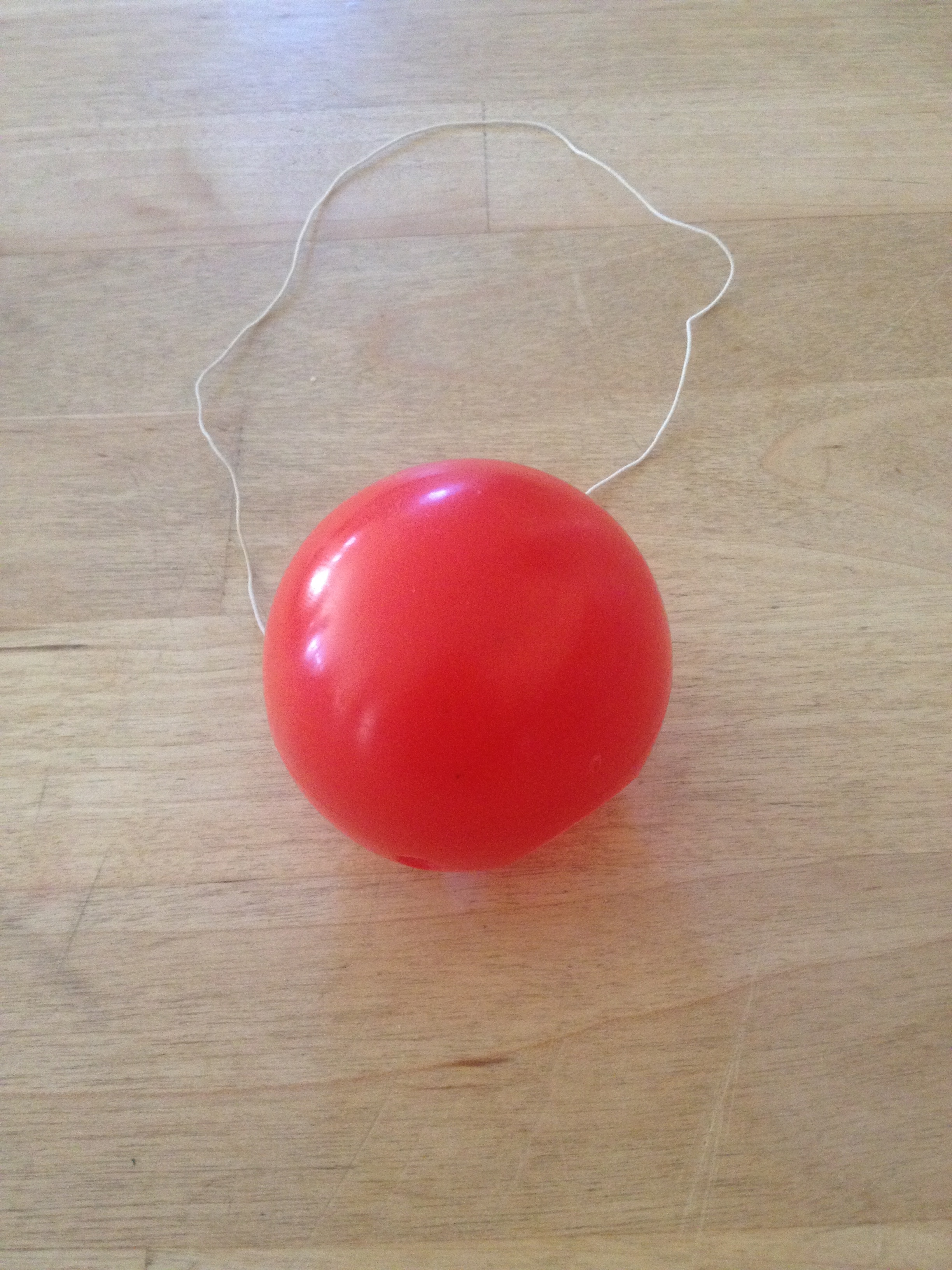
The journey of stepping into our clown-selves included putting on the red nose. This step is worthy of its own post. Putting on the red nose is putting on a mask. I was amazed at how a simple red, plastic nose became a gateway for stepping into another identity.

Noses on, hearts open and bodies warmed, we then each performed on our mock stage. The idea was for each of us to come in from side-stage with a folding chair that we had to plant front and center.  We were to follow this broad stage direction as clowns/red noses. As far as clown skills/tool go, we were initially only given one.

Exhale.

Exhalation became a form of communication – it’s very own sentence. Most of us are familiar with this in day-to-day life when it comes in the form of a sigh. The sigh often means exasperation or relief. We quickly learned to begin our performances by getting on stage, doing a gesture and sooner rather than later exhaling in a way that would say something to the audience. An exhalation became the final sentence in an introduction of a story being told by the clown.

For example, one of us came on stage holding the chair, with a scowl on his face and heaviness in his step. He clearly was not happy to be moving that chair anywhere. After taking a few steps, whilst giving us a sense of his dissatisfaction, he exhaled with a huff.  We had no idea why he might be so unhappy to be bringing that chair to center stage. We could wonder why. We could laugh knowingly – familiar as we are with that scenario in our own lives: the task-we-don’t-want-to-do-but-must.

Each of us performed. I observed that as the clown steps out initially, we might look upon with them wonder or even a small smile. We give recognition to the story that is unfolding before us. When the clown exhales, we might let out a laugh. When we do this, we are also exhaling in a way that is its own sentence. We might be saying, for example, “I so relate to that.”

From there, we eagerly step into the clown’s story, wondering where it will take us all.

Each of us stepped onto our mock stage in our distinct ways. We had grumpy clown, we had angry clown, we had timid clown, we had struggling-to-move-the-chair clown, we had confident clown, we had triumphant clown, and so on. We had clowns that communicated/forged connection simply by staring into the audience silently.

Teacher added into our instruction, at some point, that usually a key ingredient of a clown’s performance is failure. The clown tries to do something very basic and finds it really challenging. The clown stumbles, falls or struggles.

Who, of us, has not stumbled, fallen or struggled in life?

As we move with the clown through their story, we tense when they tense. We sigh with relief when they sigh with relief. We rejoice with delight when they overcome an obstacle.

The clown connects with us through our hearts. Ahh, yes, I came to undersand what the teacher meant when she said that clowns forge heart connection. I hadn’t thought of clowns this way before.

In recent years, I’ve become familiar with social justice activists working with clowning to introduce sensitive subjects, e.g. HIV-AIDS and STDs, into community conversations.  I had friends who toured the world with Patch Adams – the doctor who clowns for sick children. My nickname, in a certain group of friends, is the Jester. The jester is a cousin to the clown, no? Thus, before Saturday, I had a pretty strong – albeit vague – sense that clowning is more than about making people laugh.

What I know more clearly now is that clowning can be about holding a space for people to feel connected to themselves and each other. With this in mind it isn’t surprising that our teacher began talking about clowns by emphasizing that being a clown is about giving.

An exercise we did in our clown warm ups was to go around the room with an aim to pay attention to what we were seeing. The teacher would periodically say ‘Freeze.’ At this point we would close our eyes, stop moving and point to whatever she called out, e.g. the fire flag. Clowns are very aware of their surroundings. As I’ve come to understand it, the art of clowning requires full presence – that’s part of their gift giving.

So it was, that we were encouraged first to become very present in our selves – be aware of what/how we were feeling emotionally and physically. Then we were encouraged to be present to our physical surroundings. Finally, when performing, we were nudged to be present with our audience – who, in a way, were fellow players. While performing, we were encouraged to stumble, struggle and strain a bit. By the end of it all, I had a sense that a clown can give people a story or stories that encourage us to connect with our own vulnerability.

Clowns can gift us by being vulnerable in full sight.

Presence. Vulnerability. Risk-taking. Fumbling. Struggling.

We – in the USA – live a culture in which we are often encouraged to always be strong, to hide our fears, to punish ourselves for messing up/making mistakes, to link vulnerability with shame. The clown potentially is a wise fool who reminds us that is okay to be vulnerable.

The clown potentially is a wise fool who invites us to step fully into our own humanity.

When is the last time you let yourself dance/connect with a clown, a red nose, a wise fool? What did you feel when it happened?

Posted in Uncategorized | Tagged , , , , , | 1 Comment

The Springboard of Acceptance

The dance of WiseFool circus camp and collective creativity continues. Since I last wrote (Thursday morning), we’ve done more conditioning together, learned stilts, clowning and juggling. A common theme throughout has been the importance of the practice of acceptance.  In particular, in circus camp, I am regularly being asked to accept where I am in terms of ability and strength in any given moment.

In this context, I’ve starting thinking of acceptance as a springboard. In order to leap from where I am now, I must first sink into where I am now.

I speculate that we’ve each got a set of steps in this circus camp dance that we often repeat. One routine I do is to try something, fail to be able to do it and then get angry with myself for my inability-to-do. A lot of times, this routine is part of a bigger story that goes like this: Ten years ago, I broke my back. I put a lot of time and effort it recovering my strength and developing new forms of strength, e.g. in my core. I’ve fucked up in letting myself lose strength, flexibility and overall physical fitness. I should have been a better person than I have been.

Sometimes, I’ve shared the sentiment of this story out loud at circus camp. Each time, the person who has heard me has said, in one way or another: “Okay. Well, you’re here now. You are getting fit again.”

My fellow campers have shown little interest in stepping into my little story that revolves around self-flagellation.

A variation on this dance is one where I can’t do a particular activity. My not doing it is not necessarily related to lack of strength of fitness – it is just a new activity that is taking me some time to master. Take hula-hooping. Day one that we learned it, I simply couldn’t do it. Day two came, and same again. I contemplated just giving up and sitting down and watching everyone progress on their hooping journey Instead, I went into a corner and while everyone was learning new moves, I just persisted at the basic hula-the-hoop movement.

Eventually, I got there. I still have a ways to go. I can’t sustain it for long and I don’t feel ready to try all the different movements that were taught. Regardless, what supported me to arrive at getting the basics?

The teacher supported me. She gave me tips on posture and positioning. She gave a different size hoop than the one I had grab. She encouraged me to keep trying. My fellow circus campers supported me. One, for example, saw me manage to keep the hoop up for a few seconds for the first time and congratulated me.  She did this each time I made a bit of progress. When I managed to sustain hooping for a good long while, the whole class cheered.

I’m still way behind everyone else in hooping techniques. I remember on the day wondering if my inability to hoop was going to mess up the final performance we’ll be doing in a week.  I remembering thinking that and then telling myself “No. This camp is designed to allow each of us to be who and where we are in terms of ability. This camp is designed to accept each of us as we are, without judgment or shame. I’m not messing up anything for anyone.”

I’m conscious, that with this circus camp, we have quickly created a culture that nudges each of us to be more accepting of our selves and each other. At the same time, it nudges us to create relationships with our selves and one another that give rise to expansive movement rather than constraining stagnation.

I could easily have allowed myself to be led by frustration at my inability to hoop. I could have made a cup of tea, sat down and given up. I could have thrown a tantrum. I could have done all sorts of things to fight against and berate myself.  Beyond a second or two of “Dammit, why can’t I do this?” I didn’t go that route. In part, because I know that “I can’t” isn’t a really popular phrase at WiseFool. In part, because the people around me and the ethos of the camp encouraged me both to accept the reality of my present limits while also trying to move beyond them.   In part, because I knew one thing for sure – if I didn’t try, I definitely wasn’t going to get anywhere.

After class, a couple of people told me they were impressed by my persistence. As said, quite a few people shared in rejoicing when I did I manage to get some hoop-action going. We are in a restorative dance together, collectively led by acceptance, persistence, movement and belief.

In this dance, we practice giving nourishment. A teacher held a space for me to keep going at my own little thing while everyone else did the planned repertoire. I chose to bypass self-judgment and criticism for discipline and persistence. My fellow circus campers chose to cheer me on and celebrate my victories with me. Some watched me and wrote a story of the little engine that could, rather than the little engine that lagged behind or the little engine that couldn’t stay on the tracks.

Taking these steps in our dance, we are practicing the art of love, which has acceptance at its core. Contrary to what I think is conventional wisdom, acceptance is not some from of passivity. Acceptance need not lead to resignation. Quite the opposite is true in circus camp. An entwined individual and collective practice of acceptance accompanied by belief, support, persistence and discipline regularly springboards us into a beautiful space of infinite collective creative potential.

I have much gratitude for being able to experience this collective creativity rooted in acceptance as a springboard.

When is the last time you’ve had such an experience?

Posted in Uncategorized | Tagged , , | Leave a comment