What if power isn’t a zero-sum game?

Last night was day three of WiseFool Circus Camp that started on Monday. Last night, we did warm ups, acrobatics and then silks (a.ka. aerial acrobatics with hanging fabrics).  Once again, I’m finding myself thinking about power. Power is the ability to act. It also means strength.  As we go through learning acrobatics on the mat, I see a theme emerging in partner acrobatics: strength shared is strength reinforced. What follows is that power shared is power reinforced. A critical question is: what’s your orientation to power?

Contrary to what we are usually taught, power is not a zero-sum game.

Rather, we can choose to relate to power as though it is something each and everyone of us has by virtue of existing. The game –if we are won’t to think of it that way – is for each of us to work with our power to combine it with the power (ability to act, strength) of others.

In partner acrobatics, one person is the base. The other person is in movement. Sometimes, at least when learning a new move, the pair might use a spotter. Here’s what strikes me: the base is nothing without the person they are supporting. The person being supported is nothing without the base.

When we get instructions, we are constantly told to remember that we must simultaneously give awareness to and communicate with our selves and our partner. Why?

As the base, we have to be aware that we are firmly positioned – we’re the base after all. We also are asked to make sure we aren’t doing anything to damage our own bodies. Sometimes safety measure requires a simple quick self-check in. Sometimes it requires communicating with our partner – you know – “Can you move this way, please?”

Actually, this approach is a practice for the person in movement as well – be aware of self, be aware of your partner. Do no harm to either. Communicate to create safety and then navigate to create the most out of the partnership – which, of course, might involve taking risks together in order to open up creative possibility.

As I was leaving conditioning class this morning, I was talking about this with one of the teachers and a fellow student. Imagine, I said to them, if in our organizations and groups we all worked together like this. We would alternate roles – sometimes I am a base. Sometimes I am the person in movement. All the time, I am equally protecting my self and the other person/people.

All the time, I am conscious that the idea is to draw out each other’s strengths through working with our own.

What strikes me is that at the heart of these partnerships when they work well, is the existence of two dynamics: trust and equality.

We have to trust that each of us is working with our respective power to reinforce the power in the other.  We have to genuinely believe that we are equal to each other.

I haven’t fully worked through this point about equality, yet. I’m just starting to play with it. You see, in so-called progressive circles we love to talk about equality and how it is important and how we promote it. I’ve been wondering often, in recent years, to what extent do we actually live the value/principles.

What does it mean to be equality? What does it mean to truly, sincerely believe that I am equal to every other human being on this planet? When I reflect on various meetings I’ve been to over the year and various organizations I’ve worked in, I’m pretty convinced that the vast majority of us do not sincerely believe we are equal to every other human being.

That, however, is judging others. So, I’ll mention that I know for a fact that I’ve often in my life – including recently – thought myself superior to others. I’ve often also thought my self less worthy/inferior to others.

In any event, more on equality in a future post.

Early days in circus camp and I’m wondering: What if we all went about our days – particularly those of us in organizations and groups that say we are working to create a better/different world – seeking to see, bring out and build on the power/strength of ourselves and others? What if we did this with an aim to opening up our collective creative potential for social, economic and political re-creation?

Posted in Uncategorized | Leave a comment

Last night was the first day of ELEVATE – a circus ‘boot camp’ by WiseFool. I’ve written about WiseFool before (Courage on Stilts). The WiseFool motto is “Changing lives one circus at at time.” Boot camp is for two weeks and concludes with a public performance. The camp has a maximum of fifteen participants.  I’m guessing the age range of participants this year is mid-twenties to mid-sixties. I’m forty-three. I’m doing this camp in part to help me get fit again, having lapsed in my commitment to fitness these last two years.  I’m doing it in part to participate in the performing arts – unchartered territory for me. I’m doing it because I know it will be fun. I’m doing it because I’m eager to experience different ways of being in collective creativity.

We started out this first class with conditioning/warm ups. Then we went into paired exercises to lead us into mat acrobatics. One exercise involved facing your partner, clasping arms, straightening your arms while leaning back. The idea is that each of you is using the weight and pull of the other to be supported.

Since you are both leaning back at the same time, the trust is mutual – not like when one person is asked to stand and the other is asked to fall back into their arms. I got the sense that what was happening was that we were each trusting that the other was working with their own strength in the way that was needed in that moment.  A teacher explained “People’s bodies are strong.”

As part of this practice, we went back-to-back. Backs pushing against each other, we moved as though we each were sitting down in a chair. This works well when both people move at the same pace and really press their backs together. When the connection is in a state of equilibrium, the pair can smoothly walk around like this.

Getting to equilibrium in fusing individual strength is an art, a practice. As I watched the teacher’s looking effortless as they demonstrated this, I thought of clowns and made a mental note: “Wow. Hats off to the art of collective clowning!”

Another exercise: one person is on the ground on all fours while the other person mirrors them (they called the person on top ‘dead bug’) by going back to back with them, arms and legs up in the air. Once balanced, the person on the bottom can start to move, one paw at a time. Ideally, the dead bug stays on their back rather than rolling off.

When we did this exercise, I welcome the spotting we had by teachers. I was nervous, to be lowering myself backwards onto someone else’s back.

Another exercise: one person on all fours, the other person sits on the edge of their back (facing, for example, north while the person on the ground is facing east), leans back and flips over. If done correctly, this movement does not involve a majorly-arched back (which due to an injury, I must avoid) or a lot of arm strength. Instead, you sort of are gently sliding into a slow back flip.

When a teacher explained this exercise, she emphasized the importance of the person on the bottom keeping their arms straight. What happens is that this creates a steady flow of strength or power that runs through the arm and into the ground. You support the weight of another person’s moving body without feeling strained.

In these exercises, I was conscious that we each had to pay equal attention to the other person’s body and to our own. Am I using my core muscles? Is my back straight? Are my arms straight? Can I do anything to give my partner more support – a shift here or a firmer stance in this way? The art seemed to be about using our bodies in ways that required least effort by utilizing our strengths appropriately. The art also required that we trust that the other person is doing the same.

Being me, I’m sitting here wondering:  What if a group or an organization (in any sector) worked together in the same way as we were doing last night? How would this compare to how we normally tend to work together? How would it feel different? How might the outcomes be different? In what ways might we be raising our game?

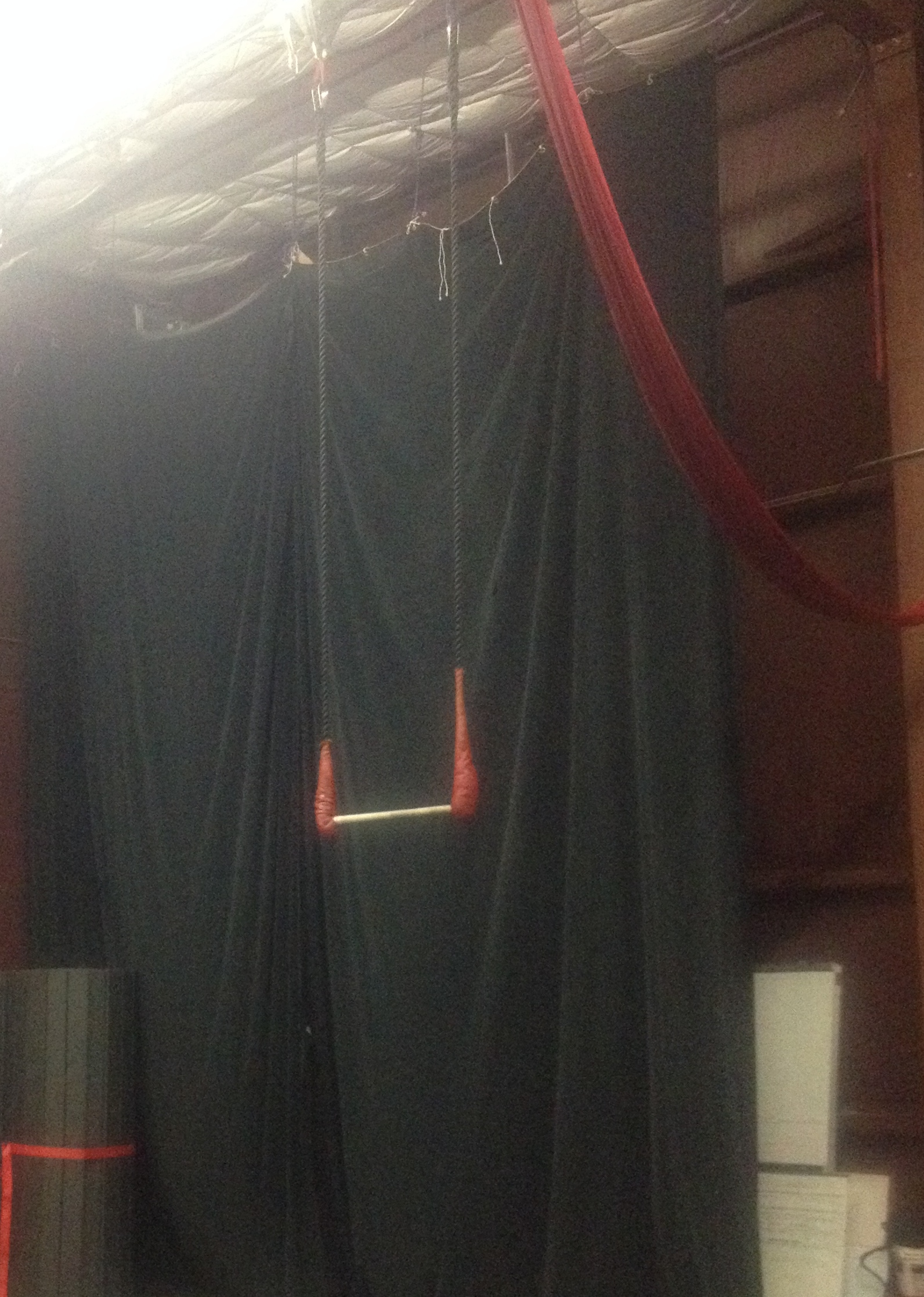
By the way, last night, we also started working on the art of trapeze. Though I’ll leave that topic for a future post, I reckon this post nevertheless hits the theme of elevating our selves – don’t you?IMG_0405

 .

Posted on by seeandconnect | Leave a comment

Reflections on 2013 – the YEAR OF TRUST AND SURRENDER

For me, 2013 was the YEAR OF TRUST AND SURRENDER. When I set that theme back at at the beginning of the year (originally it was going to be year of living intuitively – but within a week of 2013 starting, I changed it), I didn’t know how it would play out for me.  In November just gone, I experienced a moment where I felt myself to be an iceberg melting into an ocean. I was nowhere special when it happened. I was in my room here in Santa Fe, doing a session with my therapist via SKYPE. Yes, therapist. I am doing regular therapy and have been since the spring. I took it up as a response to a severe episode of anxiety. I had a reached a point where I was completely taken over in my self by fear. I had been dancing all my life (as long as I can remember, anyway) with a sense that life was trying to drown me rather than hold me, support me, carry me through my existence. I constantly lived in fear. In 2013, this fear decided to take over, to sit at the helm of the ship that is my mind and heart and steer me into the waves of mental and emotional paralysis. More than six months later, to have a moment of feeling like I am an iceberg melting into an ocean affirmed for me that i have begun to trust and surrender – to give my self over to life, without being afraid. 

How did this change happen?

One the one hand, I think I could write a book on that. On the other, I think I have nothing to say. So much of the journey to dissolving into the ocean is a mystery. And that’s been part what it has meant for me to trust and surrender. I wanted a clear plan and definitive steps to freeing myself from the shackles of fear. However, I was told that this isn’t how it works. I can’t plan my way out of it. I can’t have a formula that X+Y= freedom. A big first step to trust and surrendering was to be willing to enter a process of acceptance, release and re-creation. The catch, or at least to me at the time it seemed like a catch, is that no one could tell me how long it would last or even guarantee that I would come out of the mental and emotional hell in which I was burning – that I would be released from my shackles.  

I had to trust the process. 

I’m not talking about a definitive, existing 12-step process like Alcoholics Anonymous – which, I’m guessing, though it has clear steps is still very much an open-ended process. A step is like a day in the story of creation in the bible – could take you 30 seconds to take the step or 30 years. For me, the process has involved daily focused meditation (which tends to be through dance-movement), weekly therapy and moment-by-moment meditation. By this last activity, I mean observing myself moment by moment, being conscious of what beliefs and emotions are guiding me in each moment, and seeking to take action in that moment that is loving and restorative. The idea is to take responsibility for how I use my creative power, rather than to allow myself to be led in action by reaction, by old emotional wounds.

In other words, I’ve been on a journey of embedding a daily practice of loving my self. Of trusting and surrendering to a belief that I am loved and capable of loving. That I am worthy of love. That life is holding me rather than trying to drown me. That is is okay to allow myself to relax and to flow with life. That it is okay to forgive. That it is okay to disconnect from the struggle, familiar as it is to me. 

What’s been critical in this journey has been my willingness, at last, to stop looking for the silver bullet, the magic fix or cure to heal me. Rather, I’ve come to see how trusting and surrendering is about a moment by moment practice of giving myself over to life/love repeatedly. To accept that fear will keep coming to me and asking me to walk with her. Sometimes, she has useful information to provide – I am afraid because I am under threat. Most of the time, though, she is deceptive. She’s telling me old familiar, enticing stories so that she’ll have someone to walk with into the darkness. 

I do not need to be cured or fixed because I am not broken. Never was. I was misguided, misled. I was wounded and hurt. As for healing, that I have needed. Stepping into trusting and surrendering has very much been a journey of healing. Still is. The journey doesn’t really have an ending. The journey is living, being human. Each day I am alive, I am being asked to trust and surrender. On some days, in some moments this is easy. On other days, in other moments this is hard. Over time, I imagine, it all becomes easier – and happens unconsciously. I am in a process of re-wiring my brain, changing the default modes. I am in a process of opening my heart – dismantling the walls I had built around it. 

In my last session a week ago, my therapist asked me: “Where were you and how were you feeling this time last year?” My answer: “I was starting to fall into an abyss of fear – I was feeling frightened, insecure, confused.” 

“How are you feeling now?” he then asked.

“At ease, relaxed, open.” I responded. 

What a difference a year can make…..

Wishing you a New Year full of much love, laughter, joy, clarity and conscious creativity.

Posted in Uncategorized | Leave a comment

Stepping into the Silences….

This morning, I was introduced to a story of the Senegalese Filmmaker, Sembene.  I was invited to watch snippets of a film-in-the-making about his life, his message, his impact. I heard about his story, as well as the stories of the two men behind the film: Samba Gadjigo and Jason Silverman. Very quickly, I found myself in movement. Tears trickled down my cheeks, a sign to me of emotional connection and shift. By the end of the presentation, I felt as though I had stepped through a portal. From where to where was I stepping? What is the difference between what lies on either side of the threshold?

The difference is my relationship with my story of self and my identity as a storyteller.

“They say we who walk this world are made of flesh and blood. I say we are made of stories.” Bubuka from Senegal (taken from the Sembene site video clip).

Sembene was a storyteller who sought to open up and expand the stories of Black African Senegalese people. As I watched the film and listened to its narrator Samba speak (both in person and on the screen), I was gently reminded of my own life story. Or at least, I was reminded of dimensions to my story that I think run powerfully through my identity. What moved inside me, what shifted was my relationship with these dimensions. If I am honest with myself, in different ways over the years, I have not been willing to step fully into these dimensions, into these stories of who I’ve been, who I am and who I can be.

By not fully stepping into them, I mean that I have been reluctant to claim them as sources of wisdom and strength.

All my life, I’ve been writing and thinking and grappling with the theme of invisibility and of being in the margins. I had a sense in my early twenties that the margins were not to be dismissed as spaces of passivity and victimization. In my MA dissertation, My Basement Was No Trivia, I was eager to shout to the world that the margins are places of valuable creative power.

My life has revolved around the margins – around a sense of being constantly the outsider. As a social justice activist, I tended to see my task at hand as one of trying to change the center, change the people in the center. Yet, a lot of the time, I was doing an awkward dance of at once both condemning the center and wanting to be a part of it. Despite the insight I had in my early twenties, throughout my twenties and thirties, I had a very uncomfortable relationship with being in the margins. Much of time, I resented it.

I now see that for much of my life I had embraced a disempowered life.  I had not consciously stepped into the fullness of who I am. I was wrapped up in stories that put me in roles where I was deemed of lesser worth and value.

I was a story of a fearful, subjugated, angry woman wanting affirmation and to be included. What stood between me in my power was my tendency to run away from my self. One part of me coveted a place in the center. This part of me believed that another part of me was to blame for my marginalization. I was telling myself a story that said the center was the place to be and belong and that, because of certain aspects of who I am, I was not worthy of being and belonging there.

I wanted to walk into the center by leaving a part of my self behind, in the margins – a space I believed to be the location of rejection and worthlessness.

Now I know better.

A few years ago, I started approaching social justice and my relationship with center and margins differently.

For starters, I stopped thinking in terms of center and margins. What matters, I now realize, is where I choose to center my self internally – that is, what I choose to give power to inside myself. I’ve started walking with ears and eyes wide open into the stories that had become my life. I’ve started questioning them. I’ve started challenging them. I’ve started letting go of some of them. I’ve started writing new ones.

I’ve started mourning for the loss of the stories that were never brought to life. I cry sometimes for the identities I could have lived and the relationships I could have formed, but which have been lost. They were lost because we – I and people close to me – were lost in stories that sought to push us away from our inherent beauty, our peace, our courage, our wisdom and our self-love.  I mourn the stories that can never be told, by the lives that can no longer be lived.

At the same time, I celebrate the stories yet to be written from the life I/we have lived and the life I am/we are now living. I have spent much of my life imprisoned and I’m conscious that to be able to write a story of freedom, I will continue to go into the depth of who I am. I will witness and acknowledge all that is there – the struggle, the pain, the fear, the anger, the sadness, the rage, the beauty, the joy, the imagination, the compassion and the wisdom.

I will seek in all the stories I see and hear to find what it is they have to teach me that is restorative. I will restore my self. I will tell the stories that I believe will encourage others to step into their/our creative power more boldly.

I will tell the stories that I believe will encourage me/us to write a story of freedom.

Today’s presentation of various strands of Sembene’s, Samba’s and Jason’s stories helped me cross a threshold.

I have been standing at the threshold, afraid to tell the stories that pulse through my veins and want so badly to be heard. I have been reluctant to cross over that threshold because I seem to carry many stories that want to take me/us into the silences and into that-which-I/we-do-not-talk-about.

As I listened to the stories told this morning, I was moved and I shed tears because I felt I felt kinship. I felt the kinship of people who are conscious of what it means to resist being woven into the threads of other people’s stories. I felt the kinship of people who experienced a life where they thought their worth and value would be found in an identity that was not truly their own. I felt the kinship of people in mourning for lives that were not lived.

I felt the kinship of storytellers who are willing to step into the silences.

Surrounded by my kin this morning, I was moved to cross a threshold. I was moved to step through a portal and into a new frontier. In this land, I will dare to tell the stories that I believe I am here to tell.

Thank you, Jason and Samba, for bringing your stories and Sembene’s story to me and to the world.

Posted in Uncategorized | 2 Comments

Waking up and going for a wander on Thanksgiving Day….

[Introductory note: this post goes in different directions – it is part of a wider process in which I’m grappling with what it means to be (r)evolutionary – that is, to nurture the evolution that is the base of revolution. My mind and heart are overflowing these days with many different perspectives, snapshots and stories of what being (r)evolutionary might mean in practice. Today, I’ve let myself write without caring too much about creating a well-crafted piece of writing. In other words, today I’ve given myself permission for a bit of a wander and a ramble…I hope you enjoy meandering with me…]

I’m here in the house where I grew up – a suburb north of Chicago. Today is Thanksgiving Day. I like this holiday – notwithstanding the history of it. I like it because I have learned over the years the importance of expressing gratitude, the importance of learning to spot treasure in even the darkest of places and give thanks for it. I like it because it centers around cooking and eating together – one of my favorite activities. At the same time, the history of this holiday is important to me. People here in the USA don’t agree on the history – different people adhere to different stories. The other day, Tana posted me two rather different stories, both claiming to be the Truth…Truth About Thanksgiving: Brainwashing of the American History Textbook and The Real Story of Thanksgiving. One story reminds us of the genocide of Native Americans that took place when this country was founded. The other seeks to educate us on how the story of the pilgrims is a lesson in why socialism is bad for people (I know, I know – fodder for a post of its own).

Yes, genocide. On Monday, I was on a train from Lamy, New Mexico to Chicago. I was chatting with a passenger who lives in Las Conchas, New Mexico and is a tour guide. He mentioned that the number of Navajo people killed in detention at one point was greater than the number of people killed in the Holocaust. Of course, the Navajo peoples are just one of many tribes/nations that have been diminished. Some people might respond to this by saying that it was not systematic killing – as it was in the Holocaust. It was circumstantial, i.e., the Native peoples couldn’t withstand the germs brought by the foreigners. People might argue, I’m sure, that blankets which spread disease were given as gifts with sincerity, not with intent to murder. This might be true. Even if it is, this doesn’t mitigate the impact of the beliefs and attitudes prevalent at the time that declared Native peoples to be savages (and therefore inferior, sub-human), that deemed it okay drive nations of people from the land they inhabited, that sold the idea of an authority bestowed upon the pilgrims to conquer people and land – a belief that would turn into the doctrine of manifest destiny.

I write this while not wanting to feed into the romanticization of Native peoples (which is a very broad umbrella for diverse communities/nations of people). Yes, the cultural/spiritual practices of Native peoples around the world generally are deeply connected to a relationship with the planet in which human beings are seen to be of the land and with the land rather than being the land’s master. Yes, this is in contrast to the Calvinist pilgrims and how most of us now relate to what we call the natural environment. At the same time, it would be wrong to portray Native peoples and their traditional ways of life as a lost idyll. As long as we human beings have existed, we have fought, murdered and abused each other – including within/among so-called Native nations.  That such practices occurred among Native peoples, however, does not somehow justify their murderous treatment by colonizers. Nor does it eradicate the fact that around the world, among those people we call ‘Natives’, exists ancient wisdom that has the power to restore us and the planet.

We are in need of ancient wisdom. This wisdom is a mixture of spiritual and material know-how, e.g. mysticism and specific agricultural, medical and social practices.

No matter who we are, our ancestors have participated in abuse and violence. They and we have felt pain and suffering. Driven by pain, rage and fear, we have sought either to blame our selves or blame others. We have blamed and then punished our selves and others.

We have sought to forgive and be forgiven – as a route to diminishing the pain and suffering.

In contemporary times, we seek to comfort ourselves – and we (particularly in the industrialized north/west) have created cultures of material greed in order to provide this comfort. We soothe ourselves with stuff. We allow ourselves to be overtaken by addictions of all sorts to try and numb the pain and to relinquish ourselves of responsibility for the suffering we create within and without.

We are experiencing on-going pain and suffering rooted in unhealthy relationships with land, spirit, our selves and each other.

I am writing this in the suburbs of Chicago where I was born and raised. After twenty years of being based outside USAmerica, I have recently made Santa Fe, New Mexico my home-base. This is the first time I have lived in close proximity to communities of Native peoples in USAmerica. I’ve known for many years of the on-going oppression of Native peoples here.  Since my short time in New Mexico, I have been reminded of what I have learned before: young people in Native communities have higher than average rates of drug and alcohol addiction, diabetes and suicide. The USAmerican federal government repeatedly broke land treaties made with native peoples. Across the country, the lands that were once sources of sustenance for Native peoples have been/are being destroyed to feed our endless consumption. Practices such as the building of dams, fracking for oil and gas extraction, coal mines etc. do not simply wound the earth – they wound all its creatures, including us. They particularly bring harm to the people living in their proximity.

Pain and suffering.

I could continue weaving in and out of so many different stories – stories of on-going violence, betrayal and oppression. I could come at them from many different angles. I can show you how the oppressed was once the oppressor and how the oppressor was once the oppressed.

I could point my finger to blame and to castigate, over and over again.

I have a sense, however, that to do this wouldn’t be very helpful in the long run. Or at least it won’t be if it isn’t tied to some wider commitment. Commitment to what? Particularly in the industrialized north/west, we are a slowly-dying people. By this I mean, that we have become disconnected from our spirits. Spirit simply refers to our life force – that which makes us come alive (from latin – spirare or french – esprit).

Sure, anger and rage make us come alive – but in a way that is ultimately degenerative and not life-sustaining. We can allow anger and rage to give us a jolt, put fire in our bellies, but then we must let the anger and rage move through us and morph into conscious creativity rooted in love (the practice of indiscriminately nurturing well-being).  Far from making us passive, this movement into conscious creativity empowers us.

If we truly value life, we will commit to restoring (to bringing back to health and strength) ourselves and the planet.

I recently attended a native Deer Dance at Tesuque Pueblo just outside Santa Fe. The dance took place in the pueblo plaza. It was open to the public, provided you did not take pictures. When the portion of the dance we witnessed finished, my friend (a visiting artist from Palestine) and I were invited to have lunch in a local home right on the plaza. This is part of the tradition – homes are opened up and people are fed – a manifest of the spirit of generosity. At the time, it was explained to us that they say anyone who witnesses a ceremonial dance receives healing. Previously, I had heard that we ‘non-Natives’ tend to unaware that  ancient and sacred dances/ceremonies continue to be practiced among Native peoples. What is core to these dances/ceremonies are prayers for to restore and health the planet and all creation.

As I understand it, from the time their populations were decimated, Native peoples around the world have continued to sing, dance and pray for us all – for the oppressed and the oppressor. Unlike the conquistadores, however, these prayers for salvation are not rooted in beliefs of superiority/inferiority that are in turn rooted in fear, insecurity and self-loathing.

When people ask me “Why did you come to New Mexico?” I say: “The land.” In the past few years, I have come to believe that I am of the earth. The earth is, literally, my mother. My bones, my blood, my body – were all created from the earth and when I die, my physical self will return to the earth, only to be re-integrated with the elements of air, earth, water and fire and recycled again and again and again. Knowing this, I am both comforted and horrified.

I am comforted by this sense of connection with all creation. In recent years, I’ve been struggling with harmful levels of anxiety. I instinctively knew that to alleviate my self of this – to step out of fear –  I needed to spend more time among mountains, rivers and trees, in the sun and under the stars – be in the company of my natural family, as it were. I followed this instinct and reaped the benefits – the comfort, the relief and the freedom.

I am horrified by the way we routinely treat our mother, our life source and our natural family.

On this thanksgiving day, I am grateful for all keepers of ancient wisdom around the world who continue to dance, sing and pray for the planet and all creations – these people are trying to breathe new life into us. We cannot leave it to them alone, not while we go about our daily business as though some external force will redeem us whatever we do. That’s not good enough. We cannot keep poisoning and punishing the planet, our selves and each other and think that all we need to do is ask for forgiveness, pray, try to innovate and all will be well.

Life and how we live together is a collective creative process. If we want to live together differently, we have to change how and what we create together. We change when we step into awareness of who and how we are being in the present moment and then take action to be different.

I am, you are, we are all responsible for each other’s well-being and for the health of the planet. We are all responsible for what we create – or rather, we can choose to take responsibility for what we create. Time to wake up and step into responsible action – so that we in the present and our future generations might feel what it is to be humans being alive rather than humans being dis-spirited, hollow men and women living wasted lives in wasted lands.

Shanti. Shanti. Shanti.

Posted in Uncategorized | Tagged , , , , | 2 Comments

What is (R)evolution?

“We live in revolutionary times, but the revolution we are living through is a slow turning around from one set of beliefs and practices toward another, a turn so slow that most people fail to observe our society revolving — or rebelling. The true revolutionary needs to be as patient as a snail.” Rebecca Solnit in Revolution of the Snails: encounters with the Zapatistas as published in TomDispatch.com (15 January 2008)

A Scene:

Iman Aoun (Palestinian Theater Activist): Veena, have you participated in revolution?

Veena: No. And I struggle with this. I’ve met people who are putting their lives at risk in the name of revolution – who am I to talk about being revolutionary?  Now I’ve come to a point, though, where I think it is okay. I’m not claiming to be more than I am. I have experienced an internal revolution – a shift from being one way to being another. It has been a slow, hard, process. And it continues. And I’m convinced internal change and transformation matters to the collective revolution. I imagine  – I hope – that I will play a different role, make different kinds of contributions – more useful ones to social change.

Is (r)evolution a pretentious play on words? Possibly. Like all of us human beings, it is also possibly something else – possibly both this and that, however contradictory they might seem. For me, it is definitely much more than a play on words. I’ve stumbled across this form of the word revolution in different places, such as emails from Pancho at Casa de Paz in Oakland, California which included the following signature: “undocumented and unafraid, planetizing the movement of the ahimsa (r)evolution from some corner of our round borderless country…if you want to be a rebel, be kind…” I haven’t seen (r)evolution concisely defined, but we-who-use-it all seem to have in the common the desire to draw attention to the evolution component of revolution. 

What does that mean?

My working definition of (R)evolution:  the expression of power consciously and in ways that reflect  and give rise to loving, restorative relationships with our selves, each other, the planet and the collective creative process that is life.

Delving into the definition

Revolution has a variety of definitions: the overthrow of a government or system, replacing it with another; a full rotational turn on an axis; a sudden or momentus change in a situation.  The rotational definition invokes coming back to where one started. When it comes to the system/government overthrow or a sudden change to any situation, we usually don’t want to come full circle. The idea is change – for life to become different.

As we know, however, often one regime gets replaced for another that repeats the same tyranny, only in different forms. This is despite being comprised of the very people who overthrew the previous regime, in the name of change.  This is why I, like many others, choose to put the (r) in brackets – to highlight that (r)evolution has at its core evolution.  Evolution is defined as a  ‘gradual process in which something changes into a different and usually more complex or better form.’ To this, I say yes and it is a process whereby our relationships with our selves, each other and our creative processes become healthier and thus we create restorative systems, structures and ways of living together. Restorative means capable of renewing health or strength.

Love/loving.   Erich Fromm in The Art of Loving suggests: “Love… requires discipline, concentration, patience, faith, and the overcoming of narcissism. It isn’t a feeling, it is a practice…Love is not primarily a relationship to a specific person; it is an attitude, an ordination of character which determines the relatedness of the person to the whole world as a whole, not toward one object of love.”  I like this idea of love being about a person’s relationship to the world and of love being a practice – but a practice of what?

Guided by Fromm and the Zapatista (r)evolutionaries of Southern Mexico, who often talk about working to create bien estar or well-being, I define love as a practice of indiscriminately promoting and encouraging well-being. Loving means expressing love.

Power means the ability to act.   

If I were to re-write my working definition, breaking down the key words of evolution, power, love/loving and restorative, it would look like this:  the expression of the ability to act consciously and in ways that reflect and give rise to relationships (with our selves, each other, the planet and the collective creative process that is life) that, as part of a daily practice, indiscriminately promote and encourage well-being and renewed health and strength.

A meaningful practice of being (r)evolutionary requires discipline and courage and – as Rebecca Solnit emphasizes in her article (see the beginning of this post) – patience.  The Zapatistas take the caracol to symbolize their collective journey. Caracol is Spanish for both snail and the conch shell. This word brings together the slowness of the snail with the coming together of people in community/collective action as symbolized by the conch shell. The conch shell has been used for millennia in communities to call people together – to meet, to eat together, to go to battle. The spiral shape of the snail and the conch shells captures the idea that the journey is not straight-forward, not linear. Sometimes to get from A to B, one must travel via J. Sometimes, going forward entails stepping backward. Sometimes a pre-requisite to going outwards is turning inwards.

Solnit, in her explanation of caracol, draws upon the mythical stories of Old Antonio – stories said to be told by Subcomandante Marcos of the Zapatista movement. She quotes from one story that says “the hearts of men and women are in the shape of a caracol…they say…that the caracol represents entering in to the heart…..they say…that the caracol also represents exiting from the heart to walk into the world.”  Slow-paced. Both heart and mind-based. Inward-looking and outward looking. (R)evolution is a daily practice to create transformation through – as Solnit describes – “a slow turning around from one set of beliefs and practices towards another.”

I believe collective social, economic and political (r)evolution mirror and are inextricably entwined with the processes of individual internal (r)evolution and that the two go hand in hand – the question of which comes first is a red herring – they emerge simultaneously in the on-going dance that is life and how we live together.

What does (R)evolution mean to you? What is your experience of the relationship between individual internal change and collective transformation?


Posted in Uncategorized | Tagged , , , | Leave a comment

Returning to I am they are you….

Last weekend I participated in a two day Theater of the Oppressed workshop, led by Palestinian theater-activist Iman Aoun. In one exercise, we were asked to work in pairs. One person stepped into the role of an individual who had oppressed them. The partner was asked to receive the oppression – not taking on a particular role beyond that. Each person got to play out their oppressor. After doing the physical expression, we then individually wrote down a story of our experiences of being oppressed by the person we role-played. My partner for the exercise commented on how uncomfortable it felt to channel something from inside that allowed her/us to be the person that oppressor. She remarked: “I was having to connect with something inside me to play that role.” Uncomfortable, indeed, to experience the oppressor seemingly alive within ourselves.

Talking about this with a friend, Chris, the other day, I was reminded of my experience of watching the documentary The Interrupters. I wrote about this last year, in two posts: Why don’t we care more? and I am they are you.  I said to Chris (and wrote about in these posts) that when I watched the film, I had a powerful moment of identifying with the potential gun-toting, prone-to-extreme-violence person in me. I spent much of my life carrying large amounts of anger. I manifested (displayed the qualities of) anger and hate frequently in my relationships with my self, others and the collective creative process. Sometimes, it was subtle – the undermining comment, for example- but repetitive (a bit like the infamous Chinese water torture, I imagine). Sometimes it was more obvious – shouting at people. Often, the person I was directing the rage and the fury at was my self. Yet,  I also remember strong urges to physically hurt other people close to me.

I am grateful I didn’t act on those urges; I am aware that I had the potential to do so.

We live – here in the United States where I am currently residing –  in a very violent society. That is to say. We are manifesting violence over and over again. What is violence? An expression of hate, rage, fear, anger, frustration etc. We create violence to defend and protect. We create violence to offend and destroy. What concerns me is that many of us in this violent society watch the violence passively or might go so far as to condemn it, without pausing to see it in our selves. Violence, we easily believe, is something out there done by THEM, those VIOLENT PEOPLE WHO ARE SO DIFFERENT FROM US.  We might see our selves as VICTIMS. How often do we see our selves as PERPETRATORS, too? How often do we acknowledge that the two can and do co-exist within us?

I am they are you.

Have you ever manifested violence? Why? In what forms?

Posted in Uncategorized | Tagged , , , | Leave a comment

Orientation to Power

A couple of weeks ago, I was asked “What is your orientation to power?” At first I was taken aback by the question. What did it mean? I started to ask for an explanation and then I decided I didn’t need one. Just before the conversation, I had been thinking about power and chose to interpret the question to mean “Where do you think power comes from?” or “How do you define power?” or “What is your relationship to power?”

What is my relationship to power?

I used to think power was something I attain – I am given it, I take it from outside of me. Now I think power is something I unleash or tap into from inside of me.

Power, in its most basic sense, means the capacity to act or strength.

My orientation to power is the belief that my power lies in my capacity to create. I am creating all the time – I create emotions, thoughts, words, actions, stories, relationships, dynamics. In any given moment, I can choose what I do with that power.

In my current relationship with power, I am wanting to be conscious and aware.

What am I choosing to create?

Create simply means to bring into being.

What am I giving life to in any given moment?

I am wanting to work with my power to support others to tap into/unleash their power and our collective power in ways that nurture well-being.

In other words, I am wanting to root my power – my capacity to act and my strength – in the practice of love.

My orientation to power is the practice of love in how I relate to my self, others, the planet and the collective creative process that is life and how we live together.

What is your orientation to power?

Posted in Uncategorized | Tagged , , , | Leave a comment

The infinite potential of humans being in relationships…..

Yesterday, Molly and I got to talking. Molly wears a lot of hats and one of them is bringing music to hospices. In particular, she works with elderly people to help them write songs and then these songs are performed by a choir of young people.  Molly mentioned my friend Amy’s work with the choir. Molly was in a state of joy about this activity generally, but in particular about how Amy and her partner worked with the choir. Molly used the phrase “Generosity of Spirit.” This is a phrase I haven’t heard or used for some time. It is a phrase I love. Molly felt an incredible generosity of spirit coming through the choir work and in response arrived at the house with an overflow of wanting to give and support Amy and partner. We wrapped up our conversation, Molly and I, by reflecting on how one of the most underutilized resources we have is human relationship.

Actually, I wrote underutilized but that seems like the wrong word – though I’m leaving it in. I don’t like to go into the mindset of how do we use human relationships. I don’t want to use them – as though they are a mere means to an end. Or as though the idea is to step into a relationship with preconceived notions of how it is/will be. That would be a waste! Molly and I talked about human relationships in the context of imagination and creative power.

I listened to Molly say  “This is one of my favorite pieces of work. I love doing this” and  “Such generosity of spirit, I just want to do everything, give everything I can to support these women.” I saw her shining eyes and heard the spritely steps of joy dancing in her voice. I thought about people connected by a passion for the practice of love. Motivated by a desire to give of themselves in order to nurture well-being, they could come together and step into their individual and collective imaginations as a gateway to infinite possibility.

We’ve all heard the stories. A woman needs medical treatment for cancer and can’t afford it, the whole community pitches in and not only are her costs covered, but they’ve done it in such a way that any remaining money will be seed for an organization she will run when she recovers. The organization will focus on dance as a vehicle for healing. True story.

As Molly’s project shows, however, people collaborating to look after each other needn’t be limited to getting each other out of tight spots.  Nor must it be about money. The music program Molly is doing is about creating relationships where people are bringing joy to each other across generations – young and old, a sharing of imagination and power to create and grow joy.

We have no idea what we can create together when we are led by love – the practice of indiscriminately nurturing well-being – and willingly step into imagination.  Our lives are not a series of problems to be solved but a set of creative relationships to be nourished and unleashed as we step into human flourishing.

When have you experienced a collaborative relationship that felt like human flourishing?  What lessons can you learn from that experience?

Posted in Uncategorized | Tagged , , , , | 1 Comment

Are we ever really led by other people? I used to think that made sense – people lead, people follow. I follow someone else’s lead. It still does make sense. However, I’ve started to wonder lately if this tells the whole story – a person follows another person.  I think that my choices – sometimes conscious, sometimes not – about whom to follow are determined by my relationship with my self. In other words, I don’t think I’m ever really following anyone. Instead, I am always following my self.  A key question is: What direction am I giving my self?

My mantra is that life is a collective creative process. Even my so-called ‘individual’ life is created collectively. From its very conception, my life is formed through relationship. In this way, I am interdependent and constantly impacted by what’s going on around me – who and how other people are being, systems and structures, what the planet is up to etc. I could use this – and I am sure I have – as an excuse to absolve myself of responsibility within the collective: “That’s the way things are here.” “Passed down through the genes.” “That’s just kind of the norm.” “I’ve always been like that.” “People can’t change.”

But I don’t want to do that. Quite the opposite. I want to own up to my responsibility within the collective. This past year, in a myriad of ways, I have landed on the belief that owning up to my responsibility entails accepting that (a) I have power and the obligation to be conscious of my actions and what they are bringing to the collective (b)people can change and I can change.

Adult to child: “Why did you do that?”

Child to adult: “Janie did it first!”

Adult to child: “If Janie told you to jump off a bridge, would you?”

I haven’t heard that line – the one about the bridge – in a long time. When we were kids, it was about not giving into peer pressure, especially when it was going to lead us into doing stupid and possibly harmful things. Why don’t we use this line more with each other as adults?

I think we don’t hear/say this as much as adults because so much of what we do is just ‘the way things are done’ on a day-to-day basis. If we really gave thought to ‘what am I doing and why?’ we might be stopping in our tracks a lot throughout the day. However, our days aren’t wired so much for stopping in our tracks are they?  What’s more, whether I am talking about Parliament, Congress, a small business, a large corporation or a whatever-size social justice campaigning organization, it isn’t easy to challenge the norms – not just because of lack of time.

Sure, a campaigning organization’s work might be all about challenging the norms of government. Yet, often the cultural norms within the organization give rise to oppressive, discriminatory, bullying relationships. At the same time, the way we campaign can feed cultural norms that are ultimately undermining the very values we espouse. For example, we can step into the habit of thinking of policymakers as ‘the enemy’ and frame all our actions in ‘us vs them’ and go about – as do the policymakers – being defensive and stuck in rigid posturing. This tends to leave us with so-called discussions that involve a bunch of people yelling at each other or politely dismissing each other. It rarely results in outcomes that serve a greater good.

Back to the question of self-direction.

In all the madness – and it is madness – I’ve come to see how the one thing I have control over is my response. If, indeed, I do respond rather than react.  Much of the time I’m just in auto pilot or semi-auto pilot mode. Usually this is fine – I go about my days harmlessly. Well, I seem harmless to me. But when you multiply what I’m doing by millions, it isn’t so harmless is it? And this is how we live together. Millions of us doing what we are normally doing without thinking much about it because we can’t really see the cumulative impact.

When I think about the millions, I can get overwhelmed and think “What is the point of me trying to be conscious and do things differently, if it will take millions to change anything?” Well, one million begins with one. And it happens that the one person I can change is me.

If this is all too abstract, think about recycling. We all used to throw away our plastic bottles without thinking. Now, many of us recycle without thinking – especially if it is made easy for us to do so.  This is proof that change can happen. And not everything we do in auto-pilot is ‘bad.’ To switch from one behaviorial norm to another requires consciousness of our actions and then acting differently, ultimately without thinking about it. But don’t let this example fool you – we still get so easily duped. Think about how much plastic we are using in the first instance with our obsession with bottled water. Sure, it is good to recycle plastic. But wouldn’t it be better if we weren’t creating so much plastic in the first place?

What happens is that we pat ourselves on the back for a what seems like a positive shift and then we get complacent and fall back into auto-pilot. Well, until something or someone nudges or pushes us.

Now I might do things differently in how I relate to people and planet because I see someone else doing things differently and it inspires me. I could think I am following those people. I am. My choosing to follow them, however, depends on what’s going on inside me. What beliefs, attitudes and assumptions do I have about my own power, about my self-worth about my relationship with the planet etc? These – beliefs, attitudes, assumptions etc – are what guide me and my choices about what/who inspires me and what I choose to do in response.

Sometimes, after all, I can be nudged, pushed or metaphorically slapped in the face to change a behavior. But I keep doing it. Why? Because of my relationship with my self – because of some direction I’m following that is in my head and heart. While this relationship with self was a collective creation, in any given moment, I am the only one who can take responsibility for what I give rise to out of that relationship. Do I fall into old, destructive behavior patterns or do I go “Whoaa. I’m about to do that thing again. STOP! I don’t want to do that thing. Okay, I’m going to pause to observe what I’m thinking in my mind and what I’m feeling in my body and really check to see if I’m heading in a direction that serves well-being – of my self and others.”

I’m not finding it very easy, this stepping into conscious self-direction in order to take responsibility for who/how I’m being and my contribution to the collective creative process that is how we live together. It is like learning to walk. I keep stumbling and falling. I keep doing destructive or stupid things over and over again – only now, in some ways, it all seems worse because I’m AWARE of it. Just like a toddler learning to walk doesn’t beat him/herself up for falling, neither should I. Each change is one step at a time that begins with being open to greater awareness and occurs through dogged persistence and self-compassion.

But that’s not all of it. As I said earlier, it isn’t time that is the only barrier to change. Sometimes behavior changes I want aren’t about obvious patterns – they are more about stepping out of line with cultural norms. And this can be HARD. I’ve been at work for instance, and done things that just felt like they could and sometimes should be done differently. And the only way for this to happen would be for someone to speak up.  It is one thing to change my self and my ways of being, it is another to step up and explicitly challenge a collective.

I think I will leave off here and save that topic – challenging the collective explicitly – for another posting.

In the meantime, I ask: How conscious are you, of the directions you are giving your self?

Posted on by seeandconnect | Leave a comment